


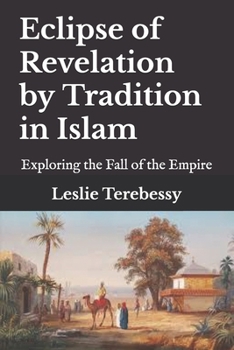
Eclipse of Revelation by Tradition in Islam: Exploring the Fall of the Empire
No Customer Reviews

The empire fell because of the "eclipse" of revelation by tradition. For it was revelation, not tradition that brought Islam to its peak. Tradition did not guide Muslims as well as revelation. The eclipse of revelation was inaugurated by the disparagement of reason. The prohibition of reasoning produced a paralysis of Muslim thought. The retreat from reason corrupted the umma's knowledge of revelation. As a result, they could not follow revelation as well as before. For it is by reasoning that we attain and follow the knowledge of revelation. As their reasoning ability waned, exegetes resorted to tradition to explain revelation. However, tradition was not able to "explain" revelation as well as reason, for tradition itself requires "explanation," as much as, if not more than revelation. However, tradition did not just "explain" revelation; it began to "judge" and even "abrogate" revelation. In different words, tradition began to take the place of revelation. In this way, tradition eclipsed both reason and revelation. As a result, the knowledge of revelation became tainted and thinking deteriorated. Revelation says, "we do not change the condition of people until they change what is in themselves." It appears that, by permitting tradition to "eclipse" that which brought prosperity - revelation - Muslims changed their knowledge of revelation. The repression of thought took the form of the widespread killing of rationalists during the reign of Musa al-Hadi in 786, as reported by al-Suyuti. This was akin to the Reign of Terror in revolutionary France in 1792, a millennium afterwards. Except that in France it was the adherents of tradition which were persecuted by the advocates of the Age of Reason or the Enlightenment. The assaults on the rationalists were reinforced by the "shutting of the gates to ijtihad," and in the renewed persecution of the rationalists by Mutawakkil beginning in 849. Al-Ghazali poured fuel on the fire by denouncing philosophers as unbelievers afterwards. The latter took place just before the arrival of the Mongols. The Mongols retaliated for the utterly un-Islamic acts of Khwarizmi Shah, first the killing of the Mongol traders and then of the ambassadors dispatched by Genghis Khan to ask for justice for the killers of the traders. These actions revealed the extent of the corruption of the Muslim rulers. They acted very differently from what would be expected from the "best community." Altogether six different phases are discernible in the transformation of Islam into Islamism. They begin and end with politics. In the first phase, politics influenced religion when the umma was encouraged to turn from revelation to tradition. The rationale for turning to tradition was the assertion that revelation requires "explanation" and "detailing" from tradition. The perception that revelation requires "clarification" from tradition rejects verses that present the Book of Allah as "clear" and "fully detailed." The ensuing phase entailed the repression of reason and its subordination to tradition. Tradition was treated as revelation in the third phase, while in the fourth phase tradition ascended to a "judge" of revelation. The fifth phase entailed recourse to the abrogation of revelation, while the sixth phase witnessed the emergence of political Islam. This entailed treated jihad al-talab as a sixth pillar of Islam" in the clash between the realm of peace and the realm of unbelief, an early variant of the "clash of civilizations" thesis. The warlike ethos of Islamism was reinforced by recourse to traditions that teach, for example, that "the blood of the kafir is halal for the believer." The teaching of "dual revelation" effectively embedded in traditionalism a dualism that was not there before the treatment of tradition as "revelation from God."
Format:Paperback
Language:English
ISBN:B093R55X31
ISBN13:9798745475481
Release Date:April 2021
Publisher:Independently Published
Length:128 Pages
Weight:0.40 lbs.
Dimensions:0.3" x 6.0" x 9.0"
Customer Reviews
0 rating
Copyright © 2026 Thriftbooks.com Terms of Use
| Privacy Policy | Do Not
Sell/Share My Personal Information | Cookie Policy | Cookie Preferences | Accessibility Statement
ThriftBooks® and the ThriftBooks® logo are registered trademarks of Thrift Books Global, LLC
ThriftBooks® and the ThriftBooks® logo are registered trademarks of Thrift Books Global, LLC
