


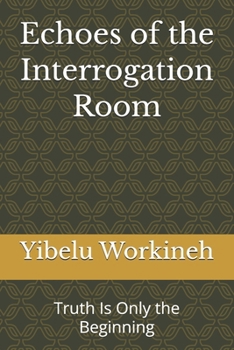
Echoes of the Interrogation Room: Truth Is Only the Beginning

"Echoes of the Interrogation Room: Truth Is Only the Beginning" is a visionary blend of psychological thriller, speculative science fiction, and philosophical inquiry. It invites readers into Room K, a futuristic interrogation chamber where memories, emotions, and fragmentary cognitive residues intertwine across time and consciousness. Here, confessions are not straightforward admissions but mosaics-composite constructs born from overlapping impressions of countless subjects. The central question becomes: whose truth is it, after all?
At the heart of the narrative is Nereth Vale, an analyst whose meticulous methodology treats truth as a fractal-infinitely complex, layered, and unstable. His obsession with dissecting testimony leads him into the labyrinth of Room K, where he partners with Elsin Rauk, the architect of this psychological-technological crucible. Together, they confront anomalies that blur the line between memory and invention, subjective experience and objective reality. Their investigation is not merely professional-it is existential, forcing them to reckon with the fragile architecture of identity and the perilous ethical terrain where justice, technology, and the human psyche converge.
The story unfolds through chapters that mirror the complexity of truth itself:
Fragments and Inconsistencies reveal the instability of memory.
Residual Cognitive Impressions explore how emotions and recollections bleed across minds.
The Blurring Line of Truth confronts the collapse of certainty.
Ethical Dilemmas and Decisions force characters to weigh justice against manipulation.
Echoes That Spread show how distorted truths ripple outward, reshaping lives and systems.
This is not a conventional crime thriller. It is a meditation on the echoing nature of human cognition-how memories resonate, overlap, and reverberate long after the original voice has faded. It challenges assumptions about the reliability of eyewitnesses, the sanctity of confession, and the very definition of justice in an era where technology can manipulate or preserve memory. Readers are asked to confront their own assumptions: Is truth a solitary thread, pure and unbroken, or a volatile mosaic, perpetually shifting under the weight of perception and influence?
The prose is both cerebral and cinematic, balancing sharp analytical detail with haunting atmosphere. It respects the gravity of its themes-justice, ethics, identity-while never losing sight of the human stories threaded through them: Nereth's relentless pursuit of fact, Elsin's controlled precision, and the silent voices of countless subjects whose confessions ripple through time. The novel's philosophical depth is matched by its narrative tension, making it both intellectually provocative and emotionally gripping.
For fans of psychological thrillers, speculative science fiction, and philosophical fiction, Echoes of the Interrogation Room offers a unique reading experience. It is a story that lingers long after the final page, leaving readers with echoes of their own-questions about memory, justice, and the mutable nature of truth itself.
This is not just a book about interrogation. It is a journey into the fragile architecture of human cognition, a confrontation with ethical paradoxes, and a testament to the resilience of those who dare to seek truth in a world where truth itself is unstable.
Customer Reviews
ThriftBooks ® and the ThriftBooks ® logo are registered trademarks of Thrift Books Global, LLC
