


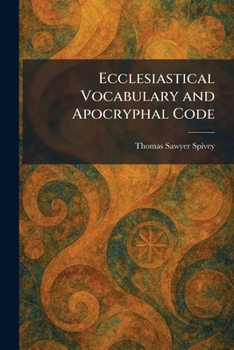
Ecclesiastical Vocabulary and Apocryphal Code

Select Format
Select Condition 
Book Overview
"Ecclesiastical Vocabulary and Apocryphal Code" is a profound exploration into the linguistic structures and hidden meanings embedded within religious terminology and scriptural texts. Authored by Thomas Sawyer Spivey, this work serves as a comprehensive guide for readers seeking to understand the deeper etymological and symbolic roots of ecclesiastical language. By dissecting the "codes" found within apocryphal and canonical writings, Spivey aims to uncover the underlying intentions and historical transformations of religious doctrine.
This volume is particularly valuable for students of theology, linguistics, and religious history, providing a critical lens through which to view the evolution of Christian vocabulary. Spivey's analytical approach challenges traditional interpretations, offering an alternative perspective on how language has been utilized to shape and preserve ecclesiastical authority over the centuries. "Ecclesiastical Vocabulary and Apocryphal Code" remains a compelling study for those interested in the intersections of faith, literature, and the power of the written word.
This work has been selected by scholars as being culturally important, and is part of the knowledge base of civilization as we know it. This work was reproduced from the original artifact, and remains as true to the original work as possible. Therefore, you may see the original copyright references, library stamps (as most of these works have been housed in our most important libraries around the world), and other notations in the work.
This work is in the public domain in the United States of America, and possibly other nations. Within the United States, you may freely copy and distribute this work, as no entity (individual or corporate) has a copyright on the body of the work.
As a reproduction of a historical artifact, this work may contain missing or blurred pages, poor pictures, errant marks, etc. Scholars believe, and we concur, that this work is important enough to be preserved, reproduced, and made generally available to the public. We appreciate your support of the preservation process, and thank you for being an important part of keeping this knowledge alive and relevant.
Customer Reviews
ThriftBooks ® and the ThriftBooks ® logo are registered trademarks of Thrift Books Global, LLC
