


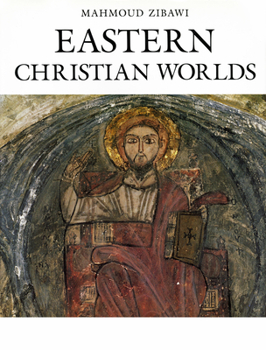
Eastern Christian Worlds

The stunning pre-quel to Zibawi's The Icon Mahmoud Zibawi's stunning book takes the reader on a journey to spiritual galaxies that have been too long neglected, although they are Christian universes and fiercely faithful to what was given at the beginning. With a majestic sweep, it presents, through both images and texts, a breath-taking view of Middle Eastern Churches - past and present - specifically in Syria, Armenia, Egypt, and Ethiopia. Many of these icons have never before been seen in print; most will appear new - and unique - as they differ in style from their Greek cousins. "Today these Churches, which are whole cultures, whole worlds, are diminished and threatened. Their art, including the present-day attempts at renewal, has been debased by the invasion of the second-rate products of Western pietism. At the very time the spiritual desert spreads, Mahmoud Zibawi reminds us - and this reminder is as good as a promise - that throughout the Christian and Muslim worlds of the East, and even farther, over deep Asia, a unique and diverse river of beauty once flowed, bringing peace and light, and that, therefore, it can do so again, provided we learn, in the very movement of the great Western 'quest, ' to rediscover its source." - from the preface.
Format:Hardcover
Language:English
ISBN:0814623751
ISBN13:9780814623756
Release Date:October 1995
Publisher:Liturgical Press
Length:272 Pages
Weight:3.90 lbs.
Dimensions:12.0" x 1.0" x 9.3"
Customer Reviews
3 ratings
Exploring the Eastern Christians
Published by Thriftbooks.com User , 22 years ago
When this book was given to me to review, the accompanying adjective was "stunning," echoing the same adjective used by Clément in his preface (7). It is indeed a stunning book; this folio size volume contains ninety-six full color plates gathered into groups and divided by country of origin. There are also 188 black and white plates interspersed throughout the text. Not a few of this plates find their first public appearance in this book. The reproduction of these plates is of top quality and the colors, particularly of the Armenian and the Ethiopic entries, are brilliant. From the point of view of art reproduction, the publishers are to be highly commended for a truly beautiful--yea, stunning--book. This volume represents a companion volume to Liturgical Press's previously issued translation of Mahmoud Zibawi, The Icon: Its Meaning and History (1993), equally "stunning" in its artwork. One can see clearly from the mere titles of these two book that the volume under review here covers a much broader territory. In this volume, Zibawi opens with a general introduction to the characteristics and history of the Eastern Mediterranean, the region in which each of these Eastern Christian Communities is found (9-20). In a second chapter, he goes on to a brief discussion of the history of the "Exchanges and Intercommunion" between the Eastern Christian communities (21-30). In Chapter 3, he compares the two primary artistic methods of the Eastern Churces, "Iconic and Aniconic," and the preferences, manifestations, and developments within each of these communities (31-46). In chapters 4 through 7, Zibawi covers the history and artistic achievement of four primary Eastern Christian Communities that he discusses: the Syrians (47-100), the Armenians (101-54), the Egyptians [= Copts] (155-208), and the Ethiopians (209-62). A very brief epilogue, followed by a Selected Bibliography, Glossary and Credits, then concludes the book (263-72). While this volume follows its predecessor in its stellar artistic reproductions, it unfortunately also follows that volume in its lack of primary scholarship and lack of overall organization. The chapters each wander back and forth from ecclesiastical and/or political history to art history to descriptions of certain works of art back to ecclesiastical history. The artistic descriptions cover nearly every type of art and architecture found in these communities: churches, carvings, icons, frescoes, manuscript illuminations, miniatures, and some sacred vessels. However, these descriptions only rarely correspond to the plates in the volume, and in the few cases that the black and white plates are described, they are almost never referenced. The descriptions are also rather superficial, describing merely the scene depicted, only rarely venturing into an evaluation of its importance or its interpretation within the community's faith and worship. References to influences of other cultures, Christian or pagan, are also sporadic and th
Brilliant!
Published by Thriftbooks.com User , 23 years ago
I was going to write a huge review to get you excited to buy this, but I see that there is already an exhaustive review. So I will only say that this book could not be better for anyone interested in eastern orthodx art of the coptic/ethiopian/egyptian sort. It is very very richly illustrated with dozens of full page full color icons. It is fantastic! Enjoy!You may also enjoy: The Resurrection and the Icon for more material on eastern orthodox iconography/theology
An unearthed treasury of icons from the Oriental Orthodox.
Published by Thriftbooks.com User , 26 years ago
Mahmoud Zibawi, Eastern Christian Worlds, trans: Madeleine Beaumont, The Liturgical Press (Collegeville, Minnesota : 1995), ISBN 0-8146-2375-1, 272 pp., Price: $US99.95(Review extracted from the Glastonbury Bulletin #100 {the Journal of the British Orthodox Church}. Reprinted by permission of editor.)We in the West seem to be experiencing a renewed Orientalism, with few more obvious signs than a singular fascination for the eastern iconographic traditions. Where icons were once assumed to inhabit the domain of populist piety or were relegated by many art historians to a developmental phase of religious art (playing, if you like, the Baptist to the messiah of the Italian Renaissance), the Orthodox icon has now come to occupy the long-vacated space of spiritual art in the popular imagination.As with all rediscoveries, however, the western appetite is highly selective and the palette likely to be attracted to those images for which it has been preconditioned. Such has been the case with both the popular and scholarly approaches to the vast heritage of iconography of the ancient world. Ten years ago, while studying icons intensively for a degree, I noted a eurocentric bias - seasoned with a hearty dose of racism - which underpinned the curriculum; indeed, more often than not the `naïf' images (`images', we were told, not `icons') of Ethiopia, when seen at all, were juxtaposed against the glittering domes of Daphni, Hosios Lukas and Nea Moni, to predictable effect. Icons were considered synonymous with Byzantium, not - significantly - with Orthodoxy. Thus those families of Orthodox existing on the geographical periphery of the empire, or whose confessions differed in substance or terminology from the prevailing Constantinopolitan conviction, were marginalised or ignored altogether.Mahmoud Zibawi's Eastern Christian Worlds succeeds brilliantly in enlivening our knowledge of the Christian religiosity of the East by focusing our attention onto the largest of such groupings, the Non-Chalcedonian Orthodox. Following upon his well-received The Icon: Its Meaning and History (The Liturgical Press, 1993), Zibawi's recent book manages the difficult feat of appearing compendious and yet comprehensive. Zibawi's book must be lauded primarily for its erudition and comprehensivity, but praise must also be accorded the author for his courage in presenting his work from an unabashedly religionist standpoint. By gathering together so many examples from the kaleidoscopic and prodigious output of the Oriental Orthodox, and then conveying the dynamic piety of the images through exuberant, if occasionally breathless, commentary, the author establishes what Olivier Clément coins in the preface as `the ecumenism of beauty'.Zibawi begins his analysis with a welcome historical introduction to the genesis of the Oriental churches. Starting, appropriately enough, with the Great Commission and Pentecost, Zibawi documents the growth
Copyright © 2026 Thriftbooks.com Terms of Use
| Privacy Policy | Do Not
Sell/Share My Personal Information | Cookie Policy | Cookie Preferences | Accessibility Statement
ThriftBooks® and the ThriftBooks® logo are registered trademarks of Thrift Books Global, LLC
ThriftBooks® and the ThriftBooks® logo are registered trademarks of Thrift Books Global, LLC
