


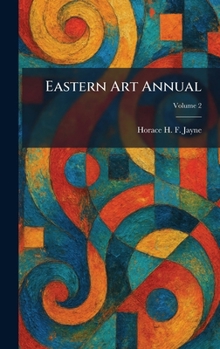
Eastern Art Annual

"Eastern Art Annual", Volume 2, edited by Horace H. F. Jayne, is a significant scholarly contribution to the study of Asian art and aesthetics. This volume serves as an essential compendium of research, featuring detailed articles on the diverse artistic traditions of the East, ranging from the intricate sculptures of India and the ceramics of China to the classical paintings of Japan and the Middle East.
As a curated collection of academic insights from the early 20th century, it provides a comprehensive overview of historical art forms, archaeological discoveries, and iconographic studies. The "Eastern Art Annual" was instrumental in bridging the gap between Western scholarship and Eastern creative expression, offering readers a deep dive into the cultural and stylistic developments that shaped the visual heritage of Asia.
With its emphasis on connoisseurship and historical context, this volume remains a valuable resource for art historians, collectors, and those interested in the profound legacy of Eastern art. It highlights the craftsmanship and philosophical foundations behind various media, including bronze, stone, and pigment, documenting the evolution of technique and form across centuries.
This work has been selected by scholars as being culturally important, and is part of the knowledge base of civilization as we know it. This work was reproduced from the original artifact, and remains as true to the original work as possible. Therefore, you may see the original copyright references, library stamps (as most of these works have been housed in our most important libraries around the world), and other notations in the work.
This work is in the public domain in the United States of America, and possibly other nations. Within the United States, you may freely copy and distribute this work, as no entity (individual or corporate) has a copyright on the body of the work.
As a reproduction of a historical artifact, this work may contain missing or blurred pages, poor pictures, errant marks, etc. Scholars believe, and we concur, that this work is important enough to be preserved, reproduced, and made generally available to the public. We appreciate your support of the preservation process, and thank you for being an important part of keeping this knowledge alive and relevant.
Customer Reviews
ThriftBooks ® and the ThriftBooks ® logo are registered trademarks of Thrift Books Global, LLC
