


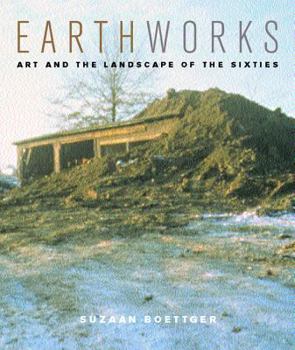
Earthworks: Art and the Landscape of the Sixties

Select Format
Select Condition 
Book Overview
Suzaan Boettger offers the first comprehensive history of the Earthworks movement in the United States, providing a fascinating and in-depth analysis of the monumental forms that initiated the broader genre of Land Art. Examining the art, the artists, their dealers and proponents, Boettger interprets Earthworks as a manifestation both of artists' personal stories and of the late 1960s social and political tumult.
Boettger overturns many commonly held notions of Earthworks' origins and intentions. She argues that Robert Smithson's work on the Dallas-Fort Worth airport stimulated his thinking and that his writing about it catalyzed the movement. The visionary environments that followed, often sculpted in expansive and remote western terrains, were idealized by Americans and Europeans alike as displays of cowboy bravado. Boettger identifies earthworkers Michael Heizer, Dennis Oppenheim, Robert Morris, Walter de Maria, and Stephen Kaltenbach as former Californians whose treatment of the landscape reflects a western spirit. Her international purview integrates early work by the Europeans Barry Flanagan, Jan Dibbets, Richard Long, and Pino Pascali as precedents and parallels. Her examination of Earthworks' relationship to the ecology movement perceptively corrects a popular misconception about the artists' goals while acknowledging the social and cultural complexities of the period.
Insightful discussions of Carl Andre, Sol LeWitt, and Claes Oldenburg--in addition to the artists mentioned above--are accompanied by many rare and new photographs of both the art and its creators. Witty, accessible, and scrupulously researched, Earthworks constructs day-to-day chronologies of the development of the artistic movement and its intersections with the larger public events of the time, including specific accounts of galleries, exhibitions, and criticism. Boettger's dynamic social history and psychological insights bring new meaning to this pivotal movement that both embodied and disrupted contemporary notions of art, nature, society, and their relationship to each other.
Boettger overturns many commonly held notions of Earthworks' origins and intentions. She argues that Robert Smithson's work on the Dallas-Fort Worth airport stimulated his thinking and that his writing about it catalyzed the movement. The visionary environments that followed, often sculpted in expansive and remote western terrains, were idealized by Americans and Europeans alike as displays of cowboy bravado. Boettger identifies earthworkers Michael Heizer, Dennis Oppenheim, Robert Morris, Walter de Maria, and Stephen Kaltenbach as former Californians whose treatment of the landscape reflects a western spirit. Her international purview integrates early work by the Europeans Barry Flanagan, Jan Dibbets, Richard Long, and Pino Pascali as precedents and parallels. Her examination of Earthworks' relationship to the ecology movement perceptively corrects a popular misconception about the artists' goals while acknowledging the social and cultural complexities of the period.
Insightful discussions of Carl Andre, Sol LeWitt, and Claes Oldenburg--in addition to the artists mentioned above--are accompanied by many rare and new photographs of both the art and its creators. Witty, accessible, and scrupulously researched, Earthworks constructs day-to-day chronologies of the development of the artistic movement and its intersections with the larger public events of the time, including specific accounts of galleries, exhibitions, and criticism. Boettger's dynamic social history and psychological insights bring new meaning to this pivotal movement that both embodied and disrupted contemporary notions of art, nature, society, and their relationship to each other.
Format:Hardcover
Language:English
ISBN:0520221087
ISBN13:9780520221086
Release Date:January 2003
Publisher:University of California Press
Length:325 Pages
Weight:0.95 lbs.
Dimensions:10.8" x 1.3" x 9.3"
Customer Reviews
2 ratings
Boettger writes with a staggering authority
Published by Thriftbooks.com User , 22 years ago
Flipping through Ms. Boettger's vitae my first impression is that she has been selling art history door to door, I began humming Willy Nelson's On the Road Again, as I scanned her long typed hodgepodge of one-night stands in whatever backwater bog had a check to write. Like the circuit pastors before her wherever the stagecoach stopped she hopped out and preached the gospel of contemporary art. A night course here, a lecture there, an awkward critique, the odd fifty-buck panel. I suspect all of that is behind her now: in this stunning debut it cannot be overstated that Ms. Boettger has produced a major historical document, one on which a McEvilley or a Krauss would be proud to place their stamp. It is meticulously researched-the sixty-nine page bibliography and notes alone are thick enough to bludgeon a thesis advisor-given that most art writing sings the rhythm of a rental lease I dreaded the 316 pages in front of me. But this writing does not drone like an academic sermon rather it engages with the timbre of a joyful story teller, I found myself in ClancyLand grabbing handfuls of pages in each sitting and looking forward to her next tale. Still her immense research underlies the imaginal prose and Ms. Boettger writes with a staggering authority, if I had not known better I would have assumed that this was her tenth book and not her first. I cannot imagine another art historian brave enough to dare a modification for at least a generation.
Exceptional art criticism
Published by Thriftbooks.com User , 22 years ago
Earthworks is simply the best contemporary art critical text I have read in years. Suzaan Boettger ambitiously sets out to integrate aesthetic issues with historical analysis, and she succeeds gracefully and adroitly. Her writing style soars. The choice of illustrations is wonderful and the level of discussion is at all times intelligent without ever becoming murky or jargon filled. Yet Boettger does not shy away from linking the various schools which contributed to Earthworks, which requires significant explanation of terms and of labels. To read this book is to gain a significant education in minimalism, post-minimalism, conceputual art, process art and even body art and the author is careful to consider each group at an international level. The author endows this book with the excitement of the times. Even a casual reader will come away with the feeling of really have been there with Robert Smithson as the Spiral Jetty was built. The distinct personalities of the players in this arena come through yet the presentation is never gossipy. The author pays enormous attention to detail when it matters, but the focus is never petty. Boettger takes chances, like including a timeline at the end, which is rare in an art book of this sort, and she succeeds magnificently. I can't say enough good things about Earthworks. There is not a disappointing page in the entire book.
Copyright © 2026 Thriftbooks.com Terms of Use
| Privacy Policy | Do Not
Sell/Share My Personal Information | Cookie Policy | Cookie Preferences | Accessibility Statement
ThriftBooks® and the ThriftBooks® logo are registered trademarks of Thrift Books Global, LLC
ThriftBooks® and the ThriftBooks® logo are registered trademarks of Thrift Books Global, LLC
