


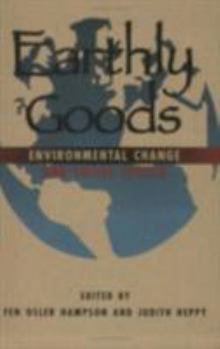
Earthly Goods


Global environmental change raises profound moral issues with which society has only begun to grapple. What does fairness mean in dividing responsibilities for problems of global warming between rich and poor nations? Does the environment itself have moral standing and, if so, how should its conflicts with the interests of people who depend on the land for their livelihood be resolved? How can the interests of the poor, of indigenous peoples, and of future generations be properly accommodated in a political discourse about environmental policy which is dominated by industrialized states? This book extends the debate both within and across disciplines, engaging philosophers, geographers, political scientists, economists, sociologists, and environmental activists from four continents. The essays address the role of science in global change and argue that western science does not provide morally disinterested solutions to environmental problems. They discuss the role of state and substate actors in the international politics of the environment, and then use accounts of actual negotiations to argue for the centrality of social justice in reaching desirable and equitable agreements. They conclude that a framework for social justice under conditions of global environmental change must include community values and provide for participatory structures to arbitrate among competing interests.
Format:Paperback
Language:English
ISBN:080148362X
ISBN13:9780801483622
Release Date:September 1996
Publisher:Cornell University Press
Length:272 Pages
Weight:0.92 lbs.
Dimensions:0.7" x 5.9" x 8.9"
Age Range:18 years and up
Grade Range:Postsecondary and higher
Customer Reviews
1 rating
Significant Contribution to the discussion
Published by Thriftbooks.com User , 25 years ago
This is a great introduction into the sociopolitical debate over climate change. In particular, it asks the question of how the everyday citizen understands climate change and its impacts. It poses intriguing questions as to how one looks at costs spread across generations and what climate change will mean not now, but decades, even centuries down the road.There are also chapters which ask wider questions on the role science plays in political decisions. The chapter by Sheila Jasanoff is especially illuminating (and highly readable) on the question of how/why scientists weigh in on debates such as climate change and what implications lie in how all knowledge, not simply scientific knowledge, is understood and valued.Overall, the collection asks the reader to investigate what the concept of "good for society" means in the debate over climate change. How does one codify "society" itself? National borders? Present Generations? How these questions are addressed have real consequences on our actions towards climate change.
Copyright © 2026 Thriftbooks.com
Terms of Use | Privacy Policy | Do Not Sell/Share My Personal Information | Cookie Policy | Cookie Preferences | Accessibility Statement
ThriftBooks ® and the ThriftBooks ® logo are registered trademarks of Thrift Books Global, LLC
ThriftBooks ® and the ThriftBooks ® logo are registered trademarks of Thrift Books Global, LLC
