


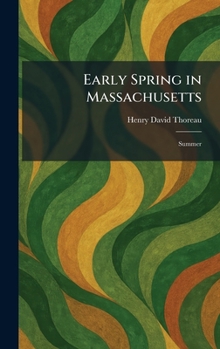
Early Spring in Massachusetts: Summer

"Early Spring in Massachusetts; And, Summer" is a profound collection of journal entries by Henry David Thoreau, one of the leading figures of American Transcendentalism. Organized chronologically to follow the rhythm of the natural year, this work presents a meticulous and poetic chronicle of the New England landscape as it awakens from winter and flourishes in the heat of the summer months.
Thoreau's keen observations capture the subtle shifts of the environment-from the first thawing of the ice and the return of migratory birds to the lush, vibrant life of the mid-year solstice. These writings offer more than mere scientific recording; they are deeply philosophical reflections on the interconnectedness of humanity and the wild. Set primarily around Concord and the surrounding wilderness, the text showcases Thoreau's signature prose style, blending intellectual rigor with a deep spiritual appreciation for the outdoors.
As a significant contribution to the genre of nature writing, this volume provides readers with an intimate look at the daily thoughts and discoveries of a master naturalist. It remains an essential work for those interested in environmental literature, American history, and the enduring beauty of the natural world.
This work has been selected by scholars as being culturally important, and is part of the knowledge base of civilization as we know it. This work was reproduced from the original artifact, and remains as true to the original work as possible. Therefore, you may see the original copyright references, library stamps (as most of these works have been housed in our most important libraries around the world), and other notations in the work.
This work is in the public domain in the United States of America, and possibly other nations. Within the United States, you may freely copy and distribute this work, as no entity (individual or corporate) has a copyright on the body of the work.
As a reproduction of a historical artifact, this work may contain missing or blurred pages, poor pictures, errant marks, etc. Scholars believe, and we concur, that this work is important enough to be preserved, reproduced, and made generally available to the public. We appreciate your support of the preservation process, and thank you for being an important part of keeping this knowledge alive and relevant.
Customer Reviews
ThriftBooks ® and the ThriftBooks ® logo are registered trademarks of Thrift Books Global, LLC
