


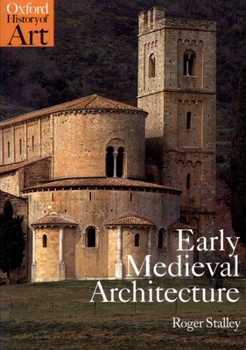
Early Medieval Architecture


Select Format
Select Condition 
Book Overview
The early middle ages were an exciting period in the history of European architecture, culminating in the development of the Romanesque style. Major architectural innovations were made during this time including the medieval castle, the church spire, and the monastic cloister. By avoiding the traditional emphasis on chronological development, Roger Stalley provides a radically new approach to the subject, exploring issues and themes rather than sequences and dates. In addition to analysing the language of the Romanesque, the book examines the engineering achievements of the builders, focusing on how the great monuments of the age were designed and constructed. Ranging from Gotland to Apulia, Stalley explores the richness and variety of European architecture in terms of the social and religious aspirations of the time. Symbolic meanings associated with architecture are also thoroughly investigated. Written with style and humour, the lively text includes many quotations from ancient sources, providing fascinating insight into the way that medieval buildings were created, and in the process enlivening study of this period.
Format:Paperback
Language:English
ISBN:0192842234
ISBN13:9780192842237
Release Date:December 1999
Publisher:Oxford University Press
Length:274 Pages
Weight:1.45 lbs.
Dimensions:0.7" x 6.6" x 9.4"
Related Subjects
Architecture Art Art History Arts, Music & Photography History History & Criticism Humanities ReferenceCustomer Reviews
3 ratings
Early Medieval Architecture
Published by Thriftbooks.com User , 20 years ago
The text arrived in good shape, and was just as described. What kept this from being a 5-star review was the sluggishness of the delivery, some 3 1/2 weeks after being ordered.
comprehensive and entertaining
Published by Thriftbooks.com User , 23 years ago
Mr. Stalley has written an excellent piece of work by combining the architecture in the early middle ages with its historical context. The content is entertaining and informative. It starts by describing the origin of the basilicas, their evolution along time and the influence that the medieval society (either royal, secular, or religious) had on both, design and construction, of these outstanding long lasting works.
Flagship Volume in New Art History Series
Published by Thriftbooks.com User , 25 years ago
Published last year, this is one of the initial volumes to appear in the extremely good, new "Oxford History of Art" series, which almost outdoes even the recent "Everyman Art Library", which it resembles. Both series are an attempt to make available up-to-the-moment overviews of selected areas of the history of building, sculpture, painting, and photography. Whereas the Everyman series seems to be open-ended, Oxford have divided their survey of world art into categories by area and/or subject, although only a handful of titles have appeared to date.Both series are superbly well printed and illustrated; each includes maps, charts, timelines, and bibliographies. What Thames and Hudson's "World of Art" series did well for several decades, these two series are now achieving in a more strictly periodizing form, with greater emphasis on method and, in the case of Oxford, on Theory.In both the Oxford and Everyman series, the most fascinating volumes are those which treat subjects broken down or combined in unusual ways. Thus, Alison Cole's "Art of the Italian Renaissance Courts" (l995) seeks to compare Naples, Urbino, Milan, Ferrara, and Mantua--- bringing relative clarity to a topic that most surveys tend to gloss over. Similarly, Loren Partridge's Everyman "The Renaissance in Rome" (1996) treats the Quattrocento and Cinquecento in the Eternal City, chapter by chapter, in terms of urban planning, churches, palaces, altarpieces, chapel decorations, and halls of state--- all in a single volume.Before Stalley, the two Oxford volumes I had read were Jas Elsner's "Imperial Rome and Christian Triumph" and Craig Clunas's "Art in China". Both are by younger scholars and are massively imbued with new (politically correct) art history. Yet both books are filled with challenging and brilliant examples and new information. In fact, the China volume is written (like all of Clunas's work) from a perspective that is truly revolutionary in Chinese studies. At the end of the day, both Elsa and Clunas are so skilled, both as writers and historians, that even the jargon of the new art history is eclipsed by the sheer quality of the two works.Roger Stalley, Professor of the History of Art, at Trinity College, Dublin, writes clearly, penetratingly, and without jargon. "Early Medieval Architecture" is deftly constructed, and the author claims that his chapters may be read "in almost any order". This may indeed be the case (I read straight through and could scarcely put the book aside). It comes, of course, as no small recommendation that Stalley was a student of Peter Kidson's.What makes "Early Medieval Architecture" unique is the editorial decision to relegate the entire topic of "late" medieval building to a separate volume by Nicola Coldstream. Therefore, hardly a mention is made of "Gothic--- the question that Stalley addresses being: "What is Romanesque?" Like its subject the book is suitably austere, yet it is
Copyright © 2026 Thriftbooks.com Terms of Use
| Privacy Policy | Do Not
Sell/Share My Personal Information | Cookie Policy | Cookie Preferences | Accessibility Statement
ThriftBooks® and the ThriftBooks® logo are registered trademarks of Thrift Books Global, LLC
ThriftBooks® and the ThriftBooks® logo are registered trademarks of Thrift Books Global, LLC
