


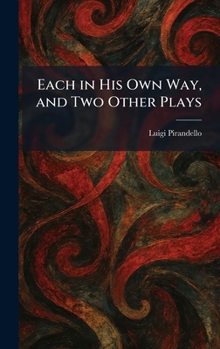
Each in His Own Way, and Two Other Plays

"Each in His Own Way, and Two Other Plays" showcases the innovative and philosophical depth of Luigi Pirandello, a master of modern drama and Nobel Prize laureate. This collection centers on the complex interplay between appearance and reality, a hallmark of Pirandello's "theater within the theater" technique. In the title play, "Each in His Own Way," the boundaries between the audience and the performers blur as the stage action mirrors a real-life scandal, provoking a visceral reaction from both the fictional spectators and the real audience alike.
Accompanying this provocative work are additional plays that further explore the author's fascination with the masks individuals wear in society and the fluid nature of truth. Through sharp dialogue and intricate psychological maneuvering, Pirandello dismantles the stability of human identity, challenging the viewer to question what is genuine and what is mere performance. These works represent a pivotal moment in the evolution of twentieth-century literature, influencing the development of the Theatre of the Absurd and existentialist drama. This collection remains an essential resource for those interested in the transformation of modern theater and the enduring power of Italian literary heritage.
This work has been selected by scholars as being culturally important, and is part of the knowledge base of civilization as we know it. This work was reproduced from the original artifact, and remains as true to the original work as possible. Therefore, you may see the original copyright references, library stamps (as most of these works have been housed in our most important libraries around the world), and other notations in the work.
This work is in the public domain in the United States of America, and possibly other nations. Within the United States, you may freely copy and distribute this work, as no entity (individual or corporate) has a copyright on the body of the work.
As a reproduction of a historical artifact, this work may contain missing or blurred pages, poor pictures, errant marks, etc. Scholars believe, and we concur, that this work is important enough to be preserved, reproduced, and made generally available to the public. We appreciate your support of the preservation process, and thank you for being an important part of keeping this knowledge alive and relevant.
Customer Reviews
ThriftBooks ® and the ThriftBooks ® logo are registered trademarks of Thrift Books Global, LLC
