


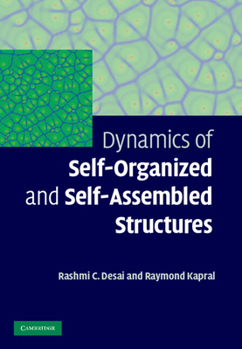
Dynamics of Self-Organized and Self-Assembled Structures
No Customer Reviews

Physical and biological systems driven out of equilibrium may spontaneously evolve to form spatial structures. In some systems molecular constituents may self-assemble to produce complex ordered structures. This book describes how such pattern formation processes occur and how they can be modeled. Experimental observations are used to introduce the diverse systems and phenomena leading to pattern formation. The physical origins of various spatial structures are discussed, and models for their formation are constructed. In contrast to many treatments, pattern-forming processes in nonequilibrium systems are treated in a coherent fashion. The book shows how near-equilibrium and far-from-equilibrium modeling concepts are often combined to describe physical systems. This inter-disciplinary book can form the basis of graduate courses in pattern formation and self-assembly. It is a useful reference for graduate students and researchers in a number of disciplines, including condensed matter science, nonequilibrium statistical mechanics, nonlinear dynamics, chemical biophysics, materials science, and engineering.
Format:Hardcover
Language:English
ISBN:052188361X
ISBN13:9780521883610
Release Date:April 2009
Publisher:Cambridge University Press
Length:342 Pages
Weight:1.85 lbs.
Dimensions:0.8" x 6.8" x 9.7"
Customer Reviews
0 rating
Copyright © 2025 Thriftbooks.com
Terms of Use | Privacy Policy | Do Not Sell/Share My Personal Information | Cookie Policy | Cookie Preferences | Accessibility Statement
ThriftBooks ® and the ThriftBooks ® logo are registered trademarks of Thrift Books Global, LLC
ThriftBooks ® and the ThriftBooks ® logo are registered trademarks of Thrift Books Global, LLC
