


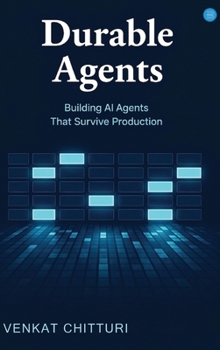
Durable Agents

AI agents are moving quickly from experimentation to enterprise deployment. Yet most will never create lasting value, not because the models are weak, but because the systems around them cannot survive production.
In Durable Agents, Venkat argues that the industry has focused on building smarter models while neglecting the harder challenge: building systems that keep working when things go wrong.
The book examines the recurring pattern seen across enterprises. An AI agent launches successfully, performs well at first, then begins to degrade through unexpected failure modes, coordination breakdowns, drifting decisions, or governance gaps. Within months, many projects stall or are taken offline.
To solve this, the book introduces the Durable Agent: a production-grade system built on five essential properties: Recoverability, Resumability, Auditability, Replaceability, and Coordination.
Readers are shown how durable execution layers enable recovery, how coordination layers create explicit handoffs between agents, humans, and systems, and how decision layers support traceability, governance, and trust.
The book also outlines how organizations can move from promising pilots to scalable production systems through the right architecture, metrics, and cross-functional ownership.
Because in the next phase of AI, the advantage will not belong to those who launch first. It will belong to those who build systems that endure in production.
Customer Reviews
ThriftBooks ® and the ThriftBooks ® logo are registered trademarks of Thrift Books Global, LLC
