


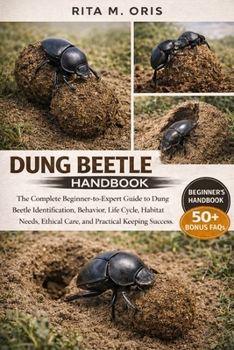
Dung Beetle Handbook: The Complete Beginner-to-Expert Guide to Dung Beetle Identification, Behavior, Life Cycle, Habitat Needs, Ethical Care, and Prac
No Customer Reviews

Introduction to Dung Beetles
Origins and Ecological Importance
Dung beetles are among the Earth's most ancient and resilient nutrient recyclers, existing long before humans learned to cultivate crops or manage livestock. Their evolutionary lineage stretches back millions of years, emerging in ecosystems where large herbivores roamed freely and created natural cycles of abundance and decay. From the beginning, dung beetles developed a remarkable specialization: transforming animal waste into fertile soil, cleaner habitats, and renewed plant growth. This may seem like a simple task at first glance, but the depth of their ecological influence is so profound that many landscapes would collapse into imbalance without their constant, tireless work. Every movement of a dung beetle, from rolling a ball to excavating tunnels, carries an ecological purpose larger than the beetle itself. They prevent parasite spread, reduce disease loads, bury nutrients for plant roots, aerate soil, and even help disperse seeds hidden within herbivore dung. These small insects operate like silent custodians of the natural world, shaping entire ecosystems through behaviors refined across deep evolutionary time.
Origins and Ecological Importance
Dung beetles are among the Earth's most ancient and resilient nutrient recyclers, existing long before humans learned to cultivate crops or manage livestock. Their evolutionary lineage stretches back millions of years, emerging in ecosystems where large herbivores roamed freely and created natural cycles of abundance and decay. From the beginning, dung beetles developed a remarkable specialization: transforming animal waste into fertile soil, cleaner habitats, and renewed plant growth. This may seem like a simple task at first glance, but the depth of their ecological influence is so profound that many landscapes would collapse into imbalance without their constant, tireless work. Every movement of a dung beetle, from rolling a ball to excavating tunnels, carries an ecological purpose larger than the beetle itself. They prevent parasite spread, reduce disease loads, bury nutrients for plant roots, aerate soil, and even help disperse seeds hidden within herbivore dung. These small insects operate like silent custodians of the natural world, shaping entire ecosystems through behaviors refined across deep evolutionary time.
Format:Paperback
Language:English
ISBN:B0GJQZSHXC
ISBN13:9798245088099
Release Date:January 2026
Publisher:Independently Published
Length:194 Pages
Weight:0.59 lbs.
Dimensions:0.4" x 6.0" x 9.0"
Related Subjects
Animals Nature Pets Pets & Animal Care Science Science & Math Science & Scientists Science & TechnologyCustomer Reviews
0 rating
Copyright © 2026 Thriftbooks.com
Terms of Use | Privacy Policy | Do Not Sell/Share My Personal Information | Cookie Policy | Cookie Preferences | Accessibility Statement
ThriftBooks ® and the ThriftBooks ® logo are registered trademarks of Thrift Books Global, LLC
ThriftBooks ® and the ThriftBooks ® logo are registered trademarks of Thrift Books Global, LLC
