


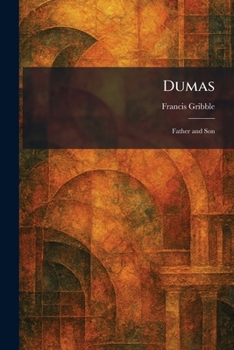
Dumas: Father and Son

Select Format
Select Condition 
Book Overview
"Dumas: Father and Son" is a compelling biographical study that explores the lives and legacies of two of France's most celebrated literary figures: Alexandre Dumas Davy de la Pailleterie, the prolific author of "The Three Musketeers", and his son, Alexandre Dumas fils, the renowned dramatist behind "La Dame aux Cam lias". Written by Francis Gribble, this work delves into the complex relationship between the two men, contrasting the elder Dumas's exuberant, adventurous lifestyle and massive literary output with the younger Dumas's more disciplined and socially conscious approach to writing.
The book provides a vivid portrait of 19th-century Parisian society, tracing the elder Dumas's rise from humble origins to international fame, his numerous romantic entanglements, and his eventual financial struggles. It simultaneously examines how the son navigated the shadow of his father's immense reputation to forge his own path as a significant playwright and moralist. Gribble's narrative captures the wit, passion, and creative energy that defined the Dumas dynasty, making it an essential read for those interested in French literary history and the personal dramas that fueled some of the world's most enduring stories.
This work has been selected by scholars as being culturally important, and is part of the knowledge base of civilization as we know it. This work was reproduced from the original artifact, and remains as true to the original work as possible. Therefore, you may see the original copyright references, library stamps (as most of these works have been housed in our most important libraries around the world), and other notations in the work.
This work is in the public domain in the United States of America, and possibly other nations. Within the United States, you may freely copy and distribute this work, as no entity (individual or corporate) has a copyright on the body of the work.
As a reproduction of a historical artifact, this work may contain missing or blurred pages, poor pictures, errant marks, etc. Scholars believe, and we concur, that this work is important enough to be preserved, reproduced, and made generally available to the public. We appreciate your support of the preservation process, and thank you for being an important part of keeping this knowledge alive and relevant.
Customer Reviews
ThriftBooks ® and the ThriftBooks ® logo are registered trademarks of Thrift Books Global, LLC
