


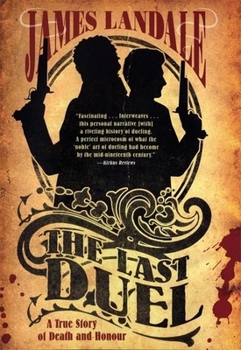
The Last Duel: A True Story of Death and Honour

Select Format
Select Condition 
Book Overview
The Last Duel is a compelling investigation of one of Europe's last recorded fatal duels by a BBC correspondent delving into his own family history. Using newly discovered archives and his family records and lore, James Landale reconstructs in vivid detail the deadly encounter between a Scottish merchant named David Landale and his banker in 1826, while also exploring the cultural and social circumstances that might explain why two rational, educated men might choose to resolve a minor business dispute by shooting at each other. Tracing the story of dueling itself, from its origins to its sudden loss of social legitimacy in the middle of the nineteenth century, Landale penetrates the curious concept called honor, which drove so many young men to an early death. The Last Duel is an utterly engrossing investigative history that, for the modern reader, renders the personal, social, and historical landscape of the time with an adept and revealing accuracy.
Format:Hardcover
Language:English
ISBN:1841958255
ISBN13:9781841958255
Release Date:September 2006
Publisher:Canongate U.S.
Length:328 Pages
Weight:1.08 lbs.
Dimensions:8.5" x 1.0" x 5.8"
Customer Reviews
2 ratings
Don't Rappers Still Have Duels?
Published by Thriftbooks.com User , 19 years ago
The 16th century Italian poet Torquato Tasso was considered by some the finest poet of his time. In fact, Tasso was so good, that when a reader of his heard another gentleman declare that contemporary writer Ludovico Ariosto was superior, the affronted Tasso fan challenged him to a duel. Afterwards, the mortally wounded Ariosto champion admitted that he hadn't actually read the poet in question at all. But duelling was so popular that to be contradicted in any opinion was enough cause to throw down the gauntlet. And so to THE LAST DUEL. I see that Rob Hardy's reader review admirably sums up the gist of this book, so I will simply add that I was prompted read it after seeing a very favorable analysis of Landale's project in THE NEW YORKER. The book was rightly praised for its elegant explanation of the rise and fall of duelling, and for its close look at the titular "last duel" between George Morgan and David Landale. As the author of the book is Landale's descendant, there is not much suspense as to the duel's outcome, but that's not the important thing here. What is fascinating about it is the closely observed history and the cultural aspects of an age of honor, a time when unread poetry could made men cross swords.
The Gentlemen's Deadly Folly
Published by Thriftbooks.com User , 19 years ago
A few miles out of the town of Kirkcaldy, Scotland, in an otherwise deserted field is a pile of stones with a simple plaque reading, "Near this site the last duel in Scotland was fought on 23rd August 1826." There is not much more to learn from going to the locale, but there is a deep and fascinating story behind the little monument. James Landale has told it in _The Last Duel: A True Story of Death and Honour_ (Canongate), not only recounting the duel, its causes, and its effects, but also giving a history of dueling. The institution was a peculiar one, but it was widespread and accepted for centuries as socially useful, with intricate codes and rules to be followed. Landale has made the story of this particular duel exciting, and while he has not exactly made dueling seem like a sensible way for people to conduct themselves, his social history of the activity helps explain how gentlemen were caught up in the system. Duels are frequently encountered in literature and film, and Landale's history puts a useful perspective on them. Linen-manufacturer David Landale (yes, a forebear of the author) was rapped by the umbrella of banker George Morgan on the high street of Kirkcaldy, and as a gentleman there was nothing he could do but issue a challenge. They had been in a financial dispute, and the furious Morgan had insisted on a written apology. He got no apology and no challenge to duel. Unable to get either, Morgan assaulted Landale with his umbrella, and the duel was on. Their seconds arranged the location and time of the duel. Thus it was that Landale met Morgan, along with their seconds and a doctor for each duelist. They took their positions ten paces from each other, and fired. For ten seconds both stood, and then Morgan crumpled to the ground, mortally wounded. Landale may have acted within the code of honor, but he had still murdered a man. He was tried for murder the next year, a trial that lasted five hours, followed by a unanimous decision from the jury which took only a couple of minutes of conference. Landale was declared not guilty, and the judge replied, "Gentlemen, this is just such a verdict as I expected from you." Landale was free to return to business, but attitudes toward dueling were changing. The last fought by Englishmen on English soil was in 1845; eventually the idea that a man's life, career, and family were less important than punctilios of honor was recognized as an outdated barbarism. The history of dueling laid out here has more than its share of oddities. Although dueling was the privilege of gentlemen, "petticoat duels" did occasionally occur, like the one in Hyde Park in 1792 after two ladies disagreed on the actual age of one of them. The first lady put a bullet hole into the hat of the second, and then, continuing with swords, the second wounded the arm of the first. There were duels using razors as the armaments, or even billiard balls thrown at the opponent's head. In 1894, two British offic
Copyright © 2026 Thriftbooks.com
Terms of Use | Privacy Policy | Do Not Sell/Share My Personal Information | Cookie Notice | Cookie Preferences | Accessibility Statement
ThriftBooks ® and the ThriftBooks ® logo are registered trademarks of Thrift Books Global, LLC
ThriftBooks ® and the ThriftBooks ® logo are registered trademarks of Thrift Books Global, LLC
