


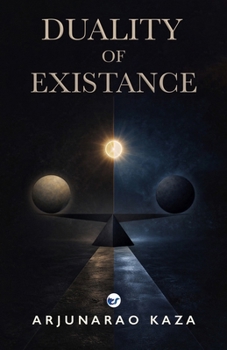
Duality of existance

Duality of Existence is a philosophical inquiry into the fundamental contradiction that underlies the universe, life, and human consciousness. The book is grounded in the premise that existence itself originates from the interaction of two eternal and opposing elements-one driven by immense, dynamic desire and the other characterized by passive, minimal desire. From this interaction arises a universe in which opposing forces are inseparable and coexist at every level of reality.
Rejecting simplistic moral binaries, the book argues that concepts such as good and bad are not independent absolutes but intrinsic aspects of existence. Every process-cosmic, biological, psychological, and social-unfolds within this duality. The pursuit of absolute goodness, purity, or perfection is presented as a misunderstanding that often leads to hypocrisy, denial, and moral distortion rather than genuine ethical clarity.
Through reflective reasoning and experiential insight, the author examines how this inherent duality manifests in human behavior, emotions, ethics, religion, and social structures. The book critically engages with idealistic spirituality, ritualistic religion, and moral absolutism, suggesting that denial of duality weakens consciousness instead of elevating it. Human maturity, the author argues, lies not in escaping conflict but in recognizing it and responding with responsibility, awareness, and restraint.
Duality of Existence does not offer comfort, prescriptions, or motivational assurances. It does not promise solutions to life's contradictions. Instead, it seeks to clarify the nature of reality as it is-complex, tense, and unresolved. The book invites readers to confront existence honestly, without illusion, and to live consciously within the unavoidable tension that defines being itself.
Customer Reviews
ThriftBooks ® and the ThriftBooks ® logo are registered trademarks of Thrift Books Global, LLC
