


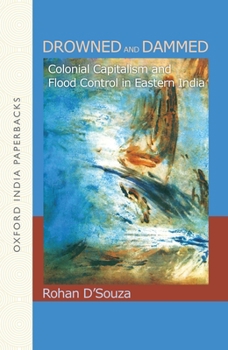
Drowned and Dammed: Colonial Capitalism and Flood Control in Eastern India
No Customer Reviews

Select Format
Select Condition 
Book Overview
This book explores the idea and practice of flood control and argues that this is a part of a political agenda, deeply implicated in the social, economic, and political calculations of capitalism in general and colonialism in particular. It argues for a comprehensive reconsideration of the debate on the colonial environmental watershed, its hydraulic legacy, and questions contemporary enthusiasm for flood control in post-independent India. The author argues that the British assembled and deployed the idea and practice of flood control in order to secure their presence in the Orissa Delta. It was principally a political project deeply implicated in the social, economic, and political calculations of capitalism in general and colonialism in particular. Through the function of flood control, colonial rule sought to organize systems of land revenue, institute capitalist private property, and shape the region's hydrology with physical infrastructure such as embankments, canal networks, and inevitably the Hirakud Dam. In seeking to dominate the delta's many rivers, colonial capitalism brought about an unprecedented ecological rupture by transforming the Orissa Delta from a flood-dependent agrarian regime to a flood-vulnerable landscape. This ecological rupture revealed the particularities of colonial capitalism in its relationships with the natural world.
Format:Paperback
Language:English
ISBN:019946913X
ISBN13:9780199469130
Release Date:November 2016
Publisher:Oxford University Press
Length:290 Pages
Weight:0.55 lbs.
Dimensions:0.7" x 5.4" x 8.4"
Customer Reviews
0 rating
Copyright © 2026 Thriftbooks.com
Terms of Use | Privacy Policy | Do Not Sell/Share My Personal Information | Cookie Policy | Cookie Preferences | Accessibility Statement
ThriftBooks ® and the ThriftBooks ® logo are registered trademarks of Thrift Books Global, LLC
ThriftBooks ® and the ThriftBooks ® logo are registered trademarks of Thrift Books Global, LLC
