


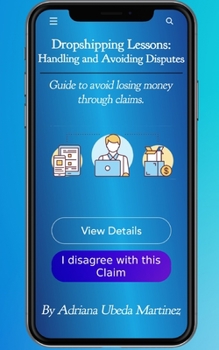
Dropshipping Lessons: Handling and Avoiding Disputes: Guide to avoid losing money through claims.
No Customer Reviews

Save couple of hundred dollar in counseling fees, and thousands of dollars in refunds by reading this book!
When it comes to handling disputes or claims, the Dropshipping Business Model is no different than any other type of business. Of course, there are particularities for this specific model that may trigger a customer to open dispute, but that is nothing we cannot handle. The most common reason customers might get upset about (for the specifics of this business model) is that the product is from and shipped from China. If a client complains about the product quality, that is not because of your business model but because of the product itself, the supplier, etc, but not because it is from China as most products are made there, including iPhones. If you ship from China using standard mail (i.e. ePacket, Aliexpress Standard Shipping), and you have on your site terms and conditions that products arrive in 10-20 business days, and that there may occur delays because of situations out of your hand such as custom clearance, weather conditions, less airport and customs personnel because of the Covid-19 situation, etc., a customer will not be able to win a dispute stating that the product never arrived (delayed) because you are already protected and have a solid argument to submit in the platform (PayPal, Stripe, Shopify, Etsy, etc) where the dispute is brought.Each store will face different problems as there is not only one way to do Dropshipping, and not all Dropshiping businesses come from China (Aliexpress), i.e. you could dropship hammocks from Nicaragua using DHL Express Shipping with a supplier found on Etsy, or Dropship smoking pipes on Shopify with a supplier on Etsy who ships using USPS, hence this book will teach you how to win or prevent disputes in an universal way. A dispute is not something you should take lightly as it can make you lose money due to malpractice, which can be avoided by reading this book. A dispute has to be won before it is opened by the Customer, meaning you should not take a passive approach and should think ahead, pathing the way before a case is brought. Other people, especially those who are starting in the e-Commerce business, might get scared when a Buyer open a claim, and agree with their request to avoid getting bad public feedback or being punished by the payment processor as this can harm your business and they can even close your account if your business is being flagged.
Having clear and strong terms and conditions on your site, notices, understanding how the platform where the dispute is brought works and its relevant T&Cs, providing relevant proof and arguments, and a good previous communication with the Customer can surely increase your odds of winning the dispute.
The following factors can surely increase your odds of winning a claim:
Knowing what constitutes and what not constitutes Unauthorized Transaction, Item Not as Described, Item Not Arrived, will surely help you draft a much better dispute/claim reply by having arguments pursuant to PayPal Terms and Conditions.Thinking like a lawyer: Knowing a PayPal dispute or claim between seller and buyer falls under PayPal Seller Protection. Unlike a lawsuit where you might need the representation of a lawyer, in this PayPal dispute/claim process you don't need the representation of a lawyer, but you need to act as the lawyer and the business person when submitting your arguments, hence you will act both as the defendant and as your own lawyer to say it in some way.Strong terms & conditions and business practices: the most common practices needed to protect your business from claims from a legal and business perspective.Know the procedure: Acknowledging the difference between a dispute and a claim, and the basics of the dispute/claim procedure.Format:Paperback
Language:English
ISBN:B09JV9XBTF
ISBN13:9798750252640
Release Date:October 2021
Publisher:Independently Published
Length:54 Pages
Weight:0.14 lbs.
Dimensions:0.1" x 5.0" x 8.0"
Customer Reviews
0 rating
Copyright © 2026 Thriftbooks.com Terms of Use
| Privacy Policy | Do Not
Sell/Share My Personal Information | Cookie Policy | Cookie Preferences | Accessibility Statement
ThriftBooks® and the ThriftBooks® logo are registered trademarks of Thrift Books Global, LLC
ThriftBooks® and the ThriftBooks® logo are registered trademarks of Thrift Books Global, LLC
