


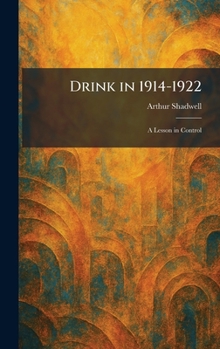
Drink in 1914-1922: A Lesson in Control

"Drink in 1914-1922 a Lesson in Control" provides an in-depth examination of the social and legislative efforts to regulate alcohol consumption in Great Britain during and immediately after the First World War. Written by Arthur Shadwell, a respected authority on social economics, this work analyzes the unique conditions created by the Great War and the subsequent governmental responses aimed at maintaining national efficiency and public order. The text focuses on the activities of the Central Control Board (Liquor Traffic) and the various experiments in state management and restrictive licensing that were implemented to mitigate the perceived evils of intemperance during a time of national crisis.
The book serves as a critical historical study of public policy and social engineering. Shadwell meticulously details the impact of shortened opening hours, the dilution of spirits, and price controls on the behavior of the working classes and the general population. By evaluating the successes and failures of these wartime measures, the author offers a "lesson in control" that remains relevant to the study of sociology and political science. This work is an essential resource for understanding the evolution of the temperance movement and the development of modern liquor laws, providing valuable insights into the intersection of wartime necessity and social reform.
This work has been selected by scholars as being culturally important, and is part of the knowledge base of civilization as we know it. This work was reproduced from the original artifact, and remains as true to the original work as possible. Therefore, you may see the original copyright references, library stamps (as most of these works have been housed in our most important libraries around the world), and other notations in the work.
This work is in the public domain in the United States of America, and possibly other nations. Within the United States, you may freely copy and distribute this work, as no entity (individual or corporate) has a copyright on the body of the work.
As a reproduction of a historical artifact, this work may contain missing or blurred pages, poor pictures, errant marks, etc. Scholars believe, and we concur, that this work is important enough to be preserved, reproduced, and made generally available to the public. We appreciate your support of the preservation process, and thank you for being an important part of keeping this knowledge alive and relevant.
Related Subjects
History Political Science Politics & Social Sciences Social Science Social SciencesCustomer Reviews
ThriftBooks ® and the ThriftBooks ® logo are registered trademarks of Thrift Books Global, LLC
