


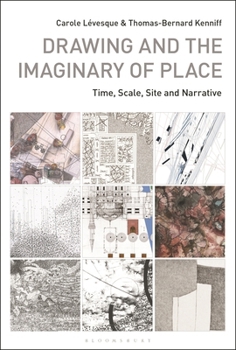
Drawing and the Imaginary of Place: Time, Scale, Site and Narrative
No Customer Reviews

The imaginary stands between us and reality like a faceted glass. It deforms, multiplies, and refracts to alter the stability and common sense of the place we physically occupy. Bridging between the real world and its potential states, imaginary places transform our perception and understanding of what is before us. Drawings of imaginary places are thus an engagement with the world, a commitment to understanding what this world carries and means to us so that we can allow it to grow into other forms.
To construct such drawings, keen and thoughtful observation of what surrounds us is necessary, as is a genuine preoccupation rooted in concrete reality. Drawings of imaginary places are reflections in action that provoke and manifest possibilities. The other-worldly drawings presented in this book are essays in of themselves, built, line by line, until they achieve a world of their own. Drawing and the Imaginary of Place brings together the drawn visions of architects, designers, artists and other disciplinary perspectives for a timely and necessary dialogue. Navigating from one imaginary place to another, a polyphonic world emerges where both singular places and their common resonance are experienced. Following the four threads of time, scale, site and narrative, this book builds a common ground for these imaginary places to cross path into a shared practice of drawing.Format:Hardcover
Language:English
ISBN:1350287458
ISBN13:9781350287457
Release Date:January 2027
Publisher:Bloomsbury Visual Arts
Length:296 Pages
Weight:1.00 lbs.
Dimensions:1.0" x 6.1" x 9.2"
Customer Reviews
0 rating
Copyright © 2026 Thriftbooks.com
Terms of Use | Privacy Policy | Do Not Sell/Share My Personal Information | Cookie Notice | Cookie Preferences | Accessibility Statement
ThriftBooks ® and the ThriftBooks ® logo are registered trademarks of Thrift Books Global, LLC
ThriftBooks ® and the ThriftBooks ® logo are registered trademarks of Thrift Books Global, LLC
