


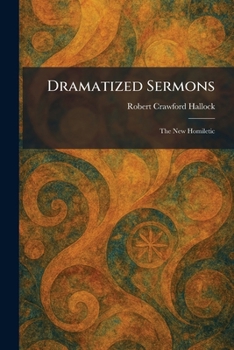
Dramatized Sermons: The New Homiletic

"Dramatized Sermons: The New Homiletic" explores an innovative and compelling approach to Christian preaching by integrating dramatic elements into the delivery of religious messages. Written by Robert Crawford Hallock, this work introduces the concept of the "New Homiletic," a method designed to make the gospel more vivid and engaging for a modern audience through the use of narrative, dialogue, and performance.
The book serves as both a theoretical guide and a practical manual for clergy and religious educators. It argues that the traditional, static sermon can be significantly enhanced by dramatization, allowing the timeless truths of scripture to resonate more deeply with congregants. Hallock provides various examples and structures for these dramatized sermons, illustrating how biblical stories and moral lessons can be brought to life on the pulpit in ways that capture the imagination.
By bridging the gap between theater and theology, "Dramatized Sermons: The New Homiletic" remains a significant historical text for those interested in the evolution of homiletics and the intersection of faith and the performing arts. It offers unique insights into the creative possibilities of the sermon format and provides a fascinating look at early 20th-century attempts to revitalize the church experience.
This work has been selected by scholars as being culturally important, and is part of the knowledge base of civilization as we know it. This work was reproduced from the original artifact, and remains as true to the original work as possible. Therefore, you may see the original copyright references, library stamps (as most of these works have been housed in our most important libraries around the world), and other notations in the work.
This work is in the public domain in the United States of America, and possibly other nations. Within the United States, you may freely copy and distribute this work, as no entity (individual or corporate) has a copyright on the body of the work.
As a reproduction of a historical artifact, this work may contain missing or blurred pages, poor pictures, errant marks, etc. Scholars believe, and we concur, that this work is important enough to be preserved, reproduced, and made generally available to the public. We appreciate your support of the preservation process, and thank you for being an important part of keeping this knowledge alive and relevant.
Customer Reviews
ThriftBooks ® and the ThriftBooks ® logo are registered trademarks of Thrift Books Global, LLC
