


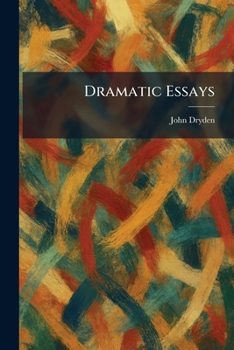
Dramatic Essays

Select Format
Select Condition 
Book Overview
"Dramatic Essays" showcases the foundational critical thought of John Dryden, a towering figure of the Restoration era and the man often hailed as the father of English criticism. This collection brings together his most influential discourses on the craft of the playwright and the evolution of the stage. Central to the volume is the celebrated "Of Dramatick Poesie, an Essay," a brilliant dialogue that compares the merits of classical, French, and English drama while exploring the virtues of blank verse versus rhyme.
Throughout these pages, Dryden provides insightful evaluations of his predecessors and contemporaries, including William Shakespeare, Ben Jonson, and the duo of Beaumont and Fletcher. His prose is characterized by its clarity, wit, and a pioneering spirit that sought to establish a uniquely English aesthetic standard. By examining the structural and emotional requirements of tragedy and comedy, Dryden offers readers a deep understanding of the neoclassicism that defined his age. "Dramatic Essays" remains an essential resource for students of literature and history, offering a window into the intellectual debates that shaped the Western theatrical tradition. It is a testament to Dryden's enduring legacy as both a master of the English language and a profound observer of the arts.
This work has been selected by scholars as being culturally important, and is part of the knowledge base of civilization as we know it. This work was reproduced from the original artifact, and remains as true to the original work as possible. Therefore, you may see the original copyright references, library stamps (as most of these works have been housed in our most important libraries around the world), and other notations in the work.
This work is in the public domain in the United States of America, and possibly other nations. Within the United States, you may freely copy and distribute this work, as no entity (individual or corporate) has a copyright on the body of the work.
As a reproduction of a historical artifact, this work may contain missing or blurred pages, poor pictures, errant marks, etc. Scholars believe, and we concur, that this work is important enough to be preserved, reproduced, and made generally available to the public. We appreciate your support of the preservation process, and thank you for being an important part of keeping this knowledge alive and relevant.
Customer Reviews
ThriftBooks ® and the ThriftBooks ® logo are registered trademarks of Thrift Books Global, LLC
