


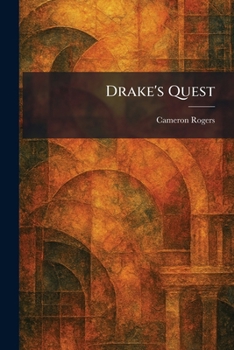
Drake's Quest

Select Format
Select Condition 
Book Overview
"Drake's Quest" is a vivid and evocative historical biography that chronicles the extraordinary life and daring voyages of Sir Francis Drake, one of England's most celebrated and controversial maritime figures. Set against the backdrop of the Elizabethan Age, Cameron Rogers presents a narrative that captures the spirit of exploration and the high-stakes geopolitical tensions between England and Spain. The work follows Drake from his early days at sea to his legendary circumnavigation of the globe, detailing his exploits as a privateer, explorer, and naval commander.
Through rich storytelling, the book explores Drake's complex character-a man of immense courage, strategic brilliance, and relentless ambition. Readers are transported to the decks of the Golden Hind as Drake navigates uncharted waters, raids Spanish ports in the New World, and ultimately plays a pivotal role in the defeat of the Spanish Armada. "Drake's Quest" serves as both an adventure tale and a historical study, offering insights into the naval tactics and the seafaring culture that defined the 16th century. This work remains a compelling tribute to the man who helped establish England as a global maritime power, making it an essential read for those interested in naval history and the Age of Discovery.
This work has been selected by scholars as being culturally important, and is part of the knowledge base of civilization as we know it. This work was reproduced from the original artifact, and remains as true to the original work as possible. Therefore, you may see the original copyright references, library stamps (as most of these works have been housed in our most important libraries around the world), and other notations in the work.
This work is in the public domain in the United States of America, and possibly other nations. Within the United States, you may freely copy and distribute this work, as no entity (individual or corporate) has a copyright on the body of the work.
As a reproduction of a historical artifact, this work may contain missing or blurred pages, poor pictures, errant marks, etc. Scholars believe, and we concur, that this work is important enough to be preserved, reproduced, and made generally available to the public. We appreciate your support of the preservation process, and thank you for being an important part of keeping this knowledge alive and relevant.
Customer Reviews
ThriftBooks ® and the ThriftBooks ® logo are registered trademarks of Thrift Books Global, LLC
