


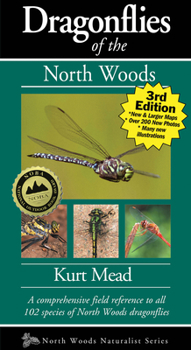
Dragonflies of the North Woods

Select Format
Select Condition 
Book Overview
Which dragonfly eats large butterflies and other dragonflies? Learn about all 102 species of dragonflies in Minnesota, Wisconsin, Michigan, and Ontario. Over 250 new photos and 30-plus new illustrations have been added to the third edition of the best-selling Dragonflies of the North Woods , which won a National Outdoor Book Award. The new maps are larger and updated with the latest survey data, and each dragonfly species has a full 2-page spread of images and information!
Format:Paperback
Language:English
ISBN:1936571110
ISBN13:9781936571116
Release Date:August 2017
Publisher:Kollath-Stensaas Publishing
Length:276 Pages
Weight:0.80 lbs.
Dimensions:0.6" x 4.5" x 8.2"
Customer Reviews
5 ratings
Great Guide to Midwest Dragonflies !
Published by Thriftbooks.com User , 15 years ago
Dragonflies of the North Woods is a wonderfully photographed, well organized and well written guide to midwest dragonflies. It's a concise yet comprehensive guide for the naturalist with sharp, detailed color photos, clear descriptions, range maps and a size guide. Helpful checklists, gear guide and appendix. Well done!
Eden is heavy with the flutter of an insect's sombre mating call.
Published by Thriftbooks.com User , 17 years ago
"David, get out there and find those dragonflies. Enjoy!"--signed by author/odonatologist Kurt Mead, B.S. (biology), BFA (art), in my copy of his 203 page, 2003 field guide, entitled "Dragonflies of the North Woods," which I bought because it covered my region of northern Ontario (as well as the northern areas of Michigan, Minnesota and Wisconsin). The definition of an insect, according to "The Audubon Society Field Guide of North American Insects and Spiders" by Lorus and Margery Milne (1980), is "...an invertebrate animal...a...Phylum Arthropoda....Class Insecta." Concerning the insect dragonfly (translated from the Romanian name "Devil's Fly"), Mead states in his book, "Dragonflies and damselflies are....odonata...'toothed ones,' a reference to the...toothy lower lip...used to capture and hold prey....'Odonata'...coined by...Fabricius in 1793." The two suborders of odes are Dragonflies, or Anisoptera--meaning different wings, and Damselflies, or Zygoptera--denoting wings that are identical (discussion of the latter just touched on near the end of this volume). Kurt's anatomy lesson on his "'Winged Dragons'" is replete with diagrams (including colour photos), and the essential facts, i.e., that a dragonfly has 30,000 lenses in one of their compound eyes. Following this is information on mating, their life cycle and behaviour. Every facet of observation/netting/collecting/photographing them are outlined, too. All 102 dragonfly species of the North Woods are meticulously investigated here in Mead's work--Darners, Clubtails, Spiketails, Cruisers, Emeralds and Skimmers, respectively--accompanied by their scientific nomenclature in italics, that's later indexed, as well. Size-bars illustrate the insect's precise length on each gloriously coloured photo, with distinguishing characteristics singled out by fieldmark arrows. And phenograms are juxtaposed to the bottom of each photo, instructing us what terrain and months that specific dragonfly can be found. This volume features a useful glossary, followed by a seven part appendix, which includes a checklist for each family/specie, list of world synonyms for dragonflies, phenology flight chart, addresses of odonata websites and groups, recommended titles (like "Beginners Guide to Dragonflies" by Blair Nikula and Jackie Sones with Donald and Lillian Stokes, 2002; but no mention of "Damselflies of the Northeast" by Ed Lam, 2004) and lastly, advice on the appropriate binoculars to use for "'Dragonflying.'" "Dragonflies of the North Woods" by Kurt Mead is irresistibly comprehensive, so visit your bookseller soon to get your copy, where Eden is heavy with the flutter of an insect's sombre mating call.
A Nice Pocket Guide
Published by Thriftbooks.com User , 17 years ago
I purchased Dragonflies of the North Woods based on recommendations of people. I live a bit south of the North Woods but most of what lives near me in Northern Illinois is said to live in the North Woods area. I am new at Dragonflies, but so far have used that book and the Stokes Beginners Guide to identify several species I had not seen before. The North Woods book has clear pictures, and for each species shows time of year they are active. There is also a little tidbit of interesting information called a Nature Note for each species. While I could wish for a range map, this book is a very useful general guide as is.
outstanding book for amateur naturalists
Published by Thriftbooks.com User , 17 years ago
This fine book is well-written, sharply-designed, and full of interesting facts about dragonfly life, as well as what you need to identify the species in the area covered. The author's obviously extensive experience shines through in the text.
Great Field Guide with Details and Humor
Published by Thriftbooks.com User , 22 years ago
Kurt provides all the details to make identification possible: clear photos, description of habitat, and the time when a species is active. In addition, the chapters at the front of the book spark your interest in this fierce predator: What is a Dragonfly, Dragonfly Biology 101, Behavior of the "Winged Dragons" and Dragonfly Observation.
Copyright © 2025 Thriftbooks.com
Terms of Use | Privacy Policy | Do Not Sell/Share My Personal Information | Cookie Policy | Cookie Preferences | Accessibility Statement
ThriftBooks ® and the ThriftBooks ® logo are registered trademarks of Thrift Books Global, LLC
ThriftBooks ® and the ThriftBooks ® logo are registered trademarks of Thrift Books Global, LLC
