


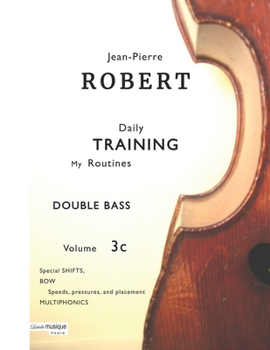
DOUBLE BASS Daily TRAINING My Routines Volume 3c: Special SHIFTS, BOW: speeds, pressures, and placements, MULTIPHONICS

This volume belongs to a set of six, designed to address proficiency levels ranging from BEGINNER through VERY ADVANCED.
These TRAINING, originally conceived for the CLASSICAL DOUBLE BASS, lend themselves readily to adaptation for JAZZ performance as well as for FRETLESS electric bass, particularly through the application of pull-off and hammer-on techniques. They comprise a structured corpus of left-hand fingering and bowing exercises founded on scales and arpeggios-still the most effective framework for developing intonation accuracy and tonal consonance. Moreover, through the use of left-hand/right-hand combinatorial works, the pedagogical orientation diverges significantly from that of conventional scale studies.
Level 1a - Bowing - and 1b - Left Hand.
These modules introduce recognition of the strings, then open-string changes across various basic articulations suitable for beginners. The left hand focuses on gentle strengthening: outlining shifts, finger articulation, and creative games with expressive markings, including initial exercises with the guiding finger. *Level 2 - Preparatory studies on shifts in the neck, construction of accuracy and intonation. Development of the guide-finger technique. Works on two strings for improving intonation in shifts, suitable as daily warm-up routines. * Level 3 my Trainings and Routines, 3a: Complex shifts, 3b: Complex routines and special scales, 3c: Special arpeggios, bow pressures and speeds, multiphonics
Daily routines: fine and complex combinations of fingerings, shifts, bow speeds/pressures/placements, including high positions.
Numerous technical situations highlighting extensions, thumb mobility, and long shifts. These often extreme and uncommon configurations are to be mastered through suppleness. Dexterities and routines
All the pages of these six training sections consist of routines. As they are not exactly exercises-being non-progressive-they may be selected in any order.
They are practiced in circular repetition. They thus aim, for example at the beginning of a work session, at attentiveness in movement, whether large or small, and at liveliness in observation and in the mind.
Tempi may be slow or fast. Yet even at a slow tempo, the gestures may remain quite dynamic; choosing one tempo, then suddenly doubling it and returning, is often of interest.
Movements benefit from occurring at the very limit, late in time. During that suspended instant, the mind sights on the gestural placement of the next note; thus may be developed perfect relaxation and speed in long motions, in the fingers, and in the mind. An example can be seen in shifts: through the rotations of the hand and thumb - smoothly anticipated-, these being chained -late in time- to the actual displacement of the hand. This also preserves and builds the movements of the back, which are other deep and less conscious gestures.
While remaining subject to musical emotion, refinement of gesture sensitivity, lucidity, perfect relaxation, and vivacity, this achievement of realization is prepared at the very initial level, in the smallest gestures of the beginner.
Customer Reviews
ThriftBooks ® and the ThriftBooks ® logo are registered trademarks of Thrift Books Global, LLC
