


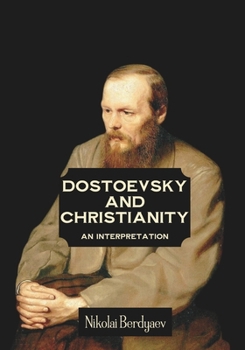
Dostoevsky and Christianity: An Interpretation by Nikolai Berdyaev

Select Format
Select Condition 
Book Overview
Dostoevsky and Christianity is Nikolai Berdyaev's classic philosophical and theological interpretation of Fyodor Dostoevsky's thought, originally published as Dostoevsky's Worldview. In this work, Berdyaev examines Dostoevsky not merely as a novelist, but as one of the most penetrating Christian thinkers of the modern era.
Berdyaev approaches Dostoevsky's major novels-Crime and Punishment, The Idiot, Demons, and The Brothers Karamazov-as expressions of a unified spiritual vision. He explores the central themes that dominate Dostoevsky's work: freedom and necessity, evil and responsibility, suffering and redemption, rebellion against God, and the spiritual fate of modern humanity. Rather than treating these ideas as literary motifs alone, Berdyaev situates them within the broader context of Christian theology and philosophy.
A central concern of the book is the problem of freedom. Berdyaev argues that Dostoevsky understood human freedom as both the greatest gift and the greatest danger, capable of leading either to sanctity or to self-destruction. He analyzes Dostoevsky's critique of rationalism, socialism, and utopian ideologies, showing how attempts to replace spiritual truth with social harmony ultimately deny the dignity of the human person.
Particular attention is given to Dostoevsky's understanding of Christ. For Berdyaev, Dostoevsky presents Christianity not as moral instruction or institutional authority, but as a living encounter between divine freedom and human freedom. This encounter exposes false forms of compassion, coercive visions of salvation, and the temptation to exchange truth for security.
Written with philosophical depth and spiritual seriousness, Dostoevsky and Christianity remains one of the most influential studies of Dostoevsky's religious thought. It is essential reading for those interested in Dostoevsky, Christian philosophy, Russian religious thought, existentialism, and the moral and spiritual crises of modern civilization.
Customer Reviews
ThriftBooks® and the ThriftBooks® logo are registered trademarks of Thrift Books Global, LLC
