


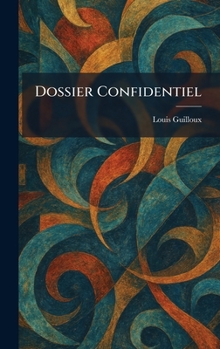
Dossier Confidentiel

"Dossier Confidentiel" is a compelling early work by the acclaimed French novelist Louis Guilloux, offering a profound exploration of memory, identity, and the weight of the past. The narrative follows a protagonist who, while sorting through a collection of personal papers and old files, embarks on an introspective journey through his youth and the formative experiences that shaped his worldview. Set against the backdrop of provincial life, the novel meticulously captures the atmosphere of early 20th-century France with the stark realism and psychological depth that would later define Guilloux's literary career.
Through its evocative prose, the book examines the tension between individual aspirations and social constraints. Guilloux delves into the complexities of human relationships and the often painful process of self-discovery. "Dossier Confidentiel" stands as a significant contribution to French social realism, providing readers with an intimate portrait of a soul in transition. This work highlights Guilloux's mastery of character development and his ability to transform ordinary life into a rich tapestry of philosophical inquiry. It is an essential read for those interested in the evolution of modern European literature and the enduring themes of nostalgia and social consciousness.
This work has been selected by scholars as being culturally important, and is part of the knowledge base of civilization as we know it. This work was reproduced from the original artifact, and remains as true to the original work as possible. Therefore, you may see the original copyright references, library stamps (as most of these works have been housed in our most important libraries around the world), and other notations in the work.
This work is in the public domain in the United States of America, and possibly other nations. Within the United States, you may freely copy and distribute this work, as no entity (individual or corporate) has a copyright on the body of the work.
As a reproduction of a historical artifact, this work may contain missing or blurred pages, poor pictures, errant marks, etc. Scholars believe, and we concur, that this work is important enough to be preserved, reproduced, and made generally available to the public. We appreciate your support of the preservation process, and thank you for being an important part of keeping this knowledge alive and relevant.
Customer Reviews
ThriftBooks ® and the ThriftBooks ® logo are registered trademarks of Thrift Books Global, LLC
