


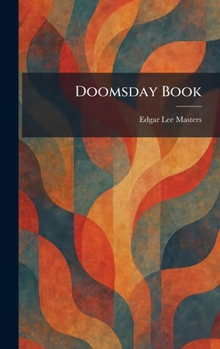
Doomsday Book

"Doomesday Book" is a profound narrative poem by Edgar Lee Masters, the celebrated author of "Spoon River Anthology". This ambitious work centers on a legal and moral inquest following the discovery of the body of Elenor Murray. Through a series of dramatic monologues and testimonies from those who knew her-including parents, lovers, and acquaintances-Masters constructs a complex psychological portrait of a single woman while simultaneously conducting a sweeping examination of the American spirit.
The poem explores themes of desire, social hypocrisy, and the search for individual meaning within a rigid societal framework. By presenting multiple, often conflicting perspectives, Masters challenges the reader to act as a juror, weighing the evidence of a life lived against the backdrop of a changing nation. "Doomesday Book" stands as a significant achievement in early 20th-century literature, blending the techniques of realism and modernism to create a sprawling, epic study of human nature and community ethics. It remains a compelling exploration of how one life can intersect with and illuminate the conscience of an entire society.
This work has been selected by scholars as being culturally important, and is part of the knowledge base of civilization as we know it. This work was reproduced from the original artifact, and remains as true to the original work as possible. Therefore, you may see the original copyright references, library stamps (as most of these works have been housed in our most important libraries around the world), and other notations in the work.
This work is in the public domain in the United States of America, and possibly other nations. Within the United States, you may freely copy and distribute this work, as no entity (individual or corporate) has a copyright on the body of the work.
As a reproduction of a historical artifact, this work may contain missing or blurred pages, poor pictures, errant marks, etc. Scholars believe, and we concur, that this work is important enough to be preserved, reproduced, and made generally available to the public. We appreciate your support of the preservation process, and thank you for being an important part of keeping this knowledge alive and relevant.
Customer Reviews
ThriftBooks ® and the ThriftBooks ® logo are registered trademarks of Thrift Books Global, LLC
