


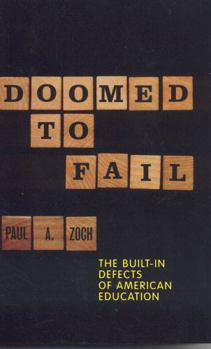
Doomed to Fail: The Built-In Defects of American Education


Select Format
Select Condition 
Book Overview
Since hardly anyone is happy with American schools, it's always open season for school reform-with inevitable calls for better teaching, better curriculums, better organization, etc., etc. In these continuing exhortations, little attention is paid to the role of the students themselves, the object of the "learning process." In this explosive book, Paul Zoch argues that what America most needs to improve its schools is not necessarily better teachers but a wholesale shift in the way it thinks about who or what creates academic success. The tendency to look to teachers for students' achievement, he maintains, is the cause of low performance. Tracing the development of educational ideas in the United States from the time of William James to the present day, Mr. Zoch shows how they have given the schools an obsessive focus on teachers and their teaching methods while neglecting the disciplined effort and hard work that students must expend in order to achieve. Because most students, in accordance with society's prevailing views, see their success as a product of what their teachers do, they devote little effort to their studies and, predictably enough, learn little. Their dedication to schoolwork, as Mr. Zoch demonstrates, falls far short of that routinely displayed by students in other, less prosperous countries. Doomed to Fail is one of the freshest and most compelling investigations of the plight of our schools to appear in many years. It is sure to create a beehive of controversy.
Format:Hardcover
Language:English
ISBN:1566635675
ISBN13:9781566635677
Release Date:May 2004
Publisher:Ivan R. Dee Publisher
Length:260 Pages
Weight:1.15 lbs.
Dimensions:1.0" x 6.3" x 9.3"
Customer Reviews
2 ratings
Identifies ideas that have caused the decline of American Public Schools
Published by Thriftbooks.com User , 20 years ago
Paul Zoch has done a great job of tying together the ideas in educational philosophy that have led to the tragic decline of American public education. His story of the psychologists, and pedagogs who enthusiastically promoted their ideas shows how the schools have been transformed for the worse. His history correctly takes up most of the book since it is important to understand the blend of diverse ideas that taken together have moved our public schools away from academic prowess. If you have an interest in the future of American public schools you must read this book. It provides the background you need to focus on the essentials of public schooling. Although he does not use the word, Mr. Zoch makes an excellent case for academic rigor. He shows how it has been removed from the public schools and the effect on students. The result is a less egalitarian, less capable of recognizing merit, public school that provide less opportunity for the students and will likely be a disaster for our nation. This trend was very well advanced when I went through the teacher training curriculum 45 years ago. At that time we joked that our professional department was good only for providing examples of how not to teach. From Mr. Zoch's descriptions things have not improved. Mr. Zoch's prescriptions are less robust and consist primarily of trying to emulate the highly centralized Japanese school system. That would not be possible since American parents have nothing comparable to the single minded concentration the Japanese families devote to their child's schooling. We might be better advised to let provision of schooling be a private matter and relegate government to the provision of partial funding. His emphasis on the primacy of intense student work on their education is refreshing. Teachers cannot drill a hole in each students skull and pour in an education. Some home-schoolers have demonstrated, in fact, that a subject outline, some books, and intense questioning can produce superior students with minimal actual "instruction." As usual the top 15 % of American students will obtain an education by attending private schools, being home-schooled or just plain taking charge of their own education. The remaining students will obtain a minimal education that is worth only a small part of the many years and countless dollars that have been devoted to it. If teachers try to run their classrooms as the current theory suggests, they are in for a lifetime of misery. The current public school system expects the impossible from teachers and then pays too little to attract expertise in any technical subject. School administrators divert attention for miserable classroom conditions by talking about minor problems such as class size, as if a slightly smaller class would make up for a "mainstreamed" psychotic or students whose parents refuse to discipline them.
Great insight into the problems with American Education
Published by Thriftbooks.com User , 22 years ago
As any good doctor knows you don't rush to a prescription until you have a good diagnosis of a problem. In trying to solve the problems of education in America it helps to understand just what are the root causes of poor performance over the last fifty years. Paul Zoch creditably claims that current efforts are doomed to fail. While reading "Doomed to Fail" often I would think about the joke of a man who comes out into a parking lot and finds a second man under a lamppost hunched over looking at the ground. The first man asks "What are you doing?" The second man says "I've lost my keys." So the first man comes over and starts to help. After a few minutes he says "I don't see them, are you sure you lost them here?" The second man says "No, I think I lost them over there where it is dark, but the light is so much better here." Paul Zoch argues very persuasively that in trying to fix problems in education by focusing on teachers, we're missing the more important issue of having the students take ownership for what they learn. He points out that when anyone learns, there is the individual learning, and the subject material being learned, there doesn't have to be a teacher. A teacher can help a student save time, but the main effort of learning has to be done by the student. The main point of this book is that by focusing on the role of teachers, we are looking in the wrong place, and we'll never find good solutions. The author explores some history of education in America and shows that a hundred years ago it was expected that students would take initiative and spend the effort to master the material. Then over the last hundred years education theories have evolved to the point where the teacher has become responsible for the students mastering subjects. So now most students sit back and expect to be entertained and somehow learn, without the students having to put forth much, if any effort. The conclusion was a bit rushed, and a bit forced. Since it appears that some of problems in American education are the result of government interference in education, it wasn't clear to me how having more government involvement would really make things better. I would have given the book five stars if the conclusion was stronger. The first six chapters provide great insight. The seventh chapter was interesting and thought provoking. The success of schools in Japan does emphasis the author's point that education is primarily the responsibility of the student. The eighth chapter's arguments for more government programs in America seemed weak. For anyone interested in why students are coming out of school with a poor, poor education, this book shines great light and is very worth reading. The book is well written and is very informative. It provides compelling arguments that efforts to improve education by focusing on teachers are doomed to fail.
Copyright © 2026 Thriftbooks.com
Terms of Use | Privacy Policy | Do Not Sell/Share My Personal Information | Cookie Notice | Cookie Preferences | Accessibility Statement
ThriftBooks ® and the ThriftBooks ® logo are registered trademarks of Thrift Books Global, LLC
ThriftBooks ® and the ThriftBooks ® logo are registered trademarks of Thrift Books Global, LLC
