


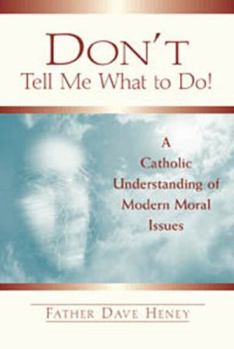
Don't Tell Me What to Do!: A Catholic Understanding of Modern Moral Issues


Select Format
Select Condition 
Book Overview
Answers to Today's Toughest Problems This straightforward book provides simple and reliable explanations of what the Catholic Church teaches and why. The book provides quick answers to questions on moral issues, explains why the Church has a fixed opinion on certain matters, and helps put into perspective those issues on which Catholics are free to dissent. This much-needed book-- --tackles hot-potato areas of sexuality, family life, medical ethics, social justice, and more. --shows how official Church positions are not arbitrarily imposed but arise naturally from human nature. --provides solid help in reaching one's own decision on moral matters. --is written in everyday language, neither "do's and don'ts" nor theological jargon. --ends each chapter with thoughtful "discussion starters." +
Format:Paperback
Language:English
ISBN:0809140748
ISBN13:9780809140749
Release Date:July 2002
Publisher:Paulist Press
Length:176 Pages
Weight:0.47 lbs.
Dimensions:0.6" x 5.5" x 8.0"
Customer Reviews
2 ratings
A Great Book for Troubled Times
Published by Thriftbooks.com User , 21 years ago
Father Dave Heney has written a great book for difficult times. It is a bridge over troubled waters. Catholics will get the most out of it for it clarifies with clear and apt examples helping them understand the conflicts. However all people of faith will profit from reading it because it gives clear guide lines to help us understand important moral issues. Personally I appreciated his starting with his cards on the table. Morality consists of Equality, Freedom,Goodness,and finally Service to others. The author says, "Most likely, we will never be sinless or perfect in our life but we can atleast be honest about it." The book's great virtue, to cover all the moral dilemmas, may be its biggest fault no one including the reviewer will agree totally with his take on each issue. Isn't that the trouble in all moral questions. We agree in general and disagree in particular. So much depends on context.
Teach Me What to Do
Published by Thriftbooks.com User , 23 years ago
Father Dave Heney has written a clear, concise guide to ethics in general and to Catholic ethics in particular. The book's strengths--it is brief, lucid, and "popular"--are its weaknesses, for it is sometimes perfunctory, sometimes curt, and sometimes simplistic. Father Heney contends that there are four "Garden of Eden virtues": equality, freedom, goodness, and service (p. 20), and this is the thread which ties together his treatment of such issues as marriage, abortion, cloning, euthanasia, and so on. Always brief and to the point, he economically explains natural law (pp. 20, 23, 29, 158), saying that we have "manufacturer's instructions" written into us (p. 20), and these we must consult as we form our consciences. He usefully points out that guilt can be good or bad (p. 19), and that we have the moral responsibility to get better (p. 25) and to live in reality (p. 51)--signs of mental and spiritual health. To know the good, we have God's Revelation and the Church's Teaching and Tradition (p. 15), especially teachings that are intense, enduring, and frequent (pp. 116, 160-161). He is at his best in pointing out our need to be grateful (p. 7) and telling us that sin is invariably a type of the first sin--pride. Another key point he makes is that Jesus constantly challenges us to grow in His love and in His grace (p. 25). Father Heney's advice about marital communication and his 5 Cs (pp. 69-72) are worthy of pondering--and of finding their way into a few homilies! He is weakest in his discussion (p. 84) of whether intercourse must always be open to life (cf. Catholic Catechism #2370 and #2366); his too brief discussion about truth and tact (p. 52) could lead readers astray; and his assertion that "the best deterrent of war remains trust" is, I am sorry to say, at the very least, historically misinformed. The "Garden virtues" he lists are surely important, but they are not absolutes; they are, rather, universal ethical obligations, but this is not the place for that discussion. The book is also plagued by a rash of errors: a "free gift" (p. 3--there's another kind?); "someone" doesn't take "they" (pp. 56, 145), and neither does "who" (p. 129); split infinitive (p. 67); confuses PRINCIPAL and PRINCIPLE (p. 111); confuses TO and TOO (p. 155); confuses EFFECT and AFFECT (p. 140); confuses AS and LIKE (p. 114); gives a "1" without a "2" (pp. 148 and 150); confuses brackets and parentheses (p. 118); but is very modern (not a compliment!)in referring to bishops as "spokespersons" (really, "spokesmen" will do; they're all men!) on page 150. Insufficiently edited! That said, this is very good book for DREs to use in parish programs. Although this book is not intended as a scholarly text, one still wishes for a solid bibliography, better indexing to Scripture, and, to be sure, a full indexing to relevant Catechism sections (a MAJOR oversight in the book). All of this is intended, I hope, as constructive criticism of what is--let me repeat--
Copyright © 2026 Thriftbooks.com
Terms of Use | Privacy Policy | Do Not Sell/Share My Personal Information | Cookie Policy | Cookie Preferences | Accessibility Statement
ThriftBooks ® and the ThriftBooks ® logo are registered trademarks of Thrift Books Global, LLC
ThriftBooks ® and the ThriftBooks ® logo are registered trademarks of Thrift Books Global, LLC
