


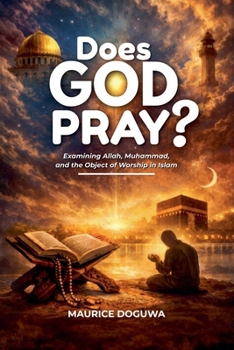
Does God Pray?

A single verse in the Qur'an raises a question many recite but few pause to examine: "Indeed, Allah and His angels pray upon the Prophet..." (Qur'an 33:56). What does it mean for God to "pray"? Why is this act directed toward a human being? And how has this verse shaped Islamic devotion as it is actually lived, not just theologically explained?
In Does God Pray?, Maurice Doguwa engages this sensitive question with care, discipline, and intellectual honesty. Rather than arguing from accusation or controversy, the book explores how devotion to Muhammad functions within Islam and why it often appears worship-like to outsiders, even as Muslims sincerely deny worshiping him.
Drawing from the Qur'an, Hadith, classical tafsir, Arabic linguistics, ritual practice, psychology, sociology, and comparative theology, Doguwa examines how language, repetition, emotion, intercession, and divine command combine to form a powerful devotional structure involving Allah, angels, and Muhammad.
The book makes crucial distinctions between stated belief and lived practice, doctrinal monotheism and functional devotion, theology on paper and religion in daily life. It explains how two seemingly opposing perceptions can coexist without contradiction.
Does God Pray? is not a polemic or an attack on faith. It is a mirror, inviting honest reflection, thoughtful dialogue, and deeper understanding of how worship and human psychology interact within Islam.
Customer Reviews
ThriftBooks ® and the ThriftBooks ® logo are registered trademarks of Thrift Books Global, LLC
