


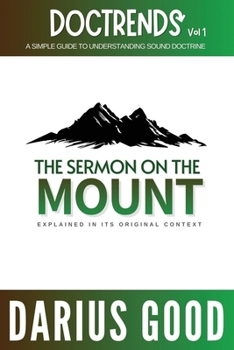
Doctrends Vol. 1: The Sermon on the Mount

The Sermon on the Mount is often preached as a set of moral ideals, with Jesus portrayed as contradicting or replacing the law of Moses. Phrases like "but I say" are commonly used to suggest a new or higher law. Yet Jesus was not opposing the law-He was calling Israel back to obedience to it in its entirety, distinguishing between "heavier" and "lighter" commandments, not abolishing any of them.
In this concise and corrective study, Darius Good presents the Sermon on the Mount as a legal and covenantal restoration, not the birth of a new religion. Speaking as a Jewish teacher born under the law, Jesus exposes the loopholes, traditions, and misapplications that had corrupted justice, marriage, righteousness, and mercy in first-century Israel. His teaching sought to restore faithful observance of the law, from the greatest commandment to the least.
Drawing on biblical text and historical and cultural context, this book reveals how distorted interpretations-especially regarding divorce, adultery, oaths, and retaliation-produced real victims, particularly women and the poor.
Far from an abstract spiritual manifesto, the Sermon on the Mount is a bold call to repentance, justice, and covenant faithfulness-one that still challenges modern Christianity to separate doctrine from tradition, and truth from doctrend.
Jesus did not change the law. He exposed what had been changed.
Customer Reviews
ThriftBooks® and the ThriftBooks® logo are registered trademarks of Thrift Books Global, LLC
