


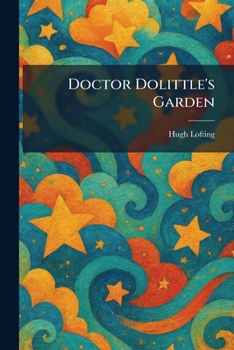



Book Overview
In "Doctor Dolittle's Garden", the world-renowned physician who can speak to animals turns his inquisitive mind toward the smallest inhabitants of his home at Puddleby-on-the-Marsh. Shifting his focus from the vast oceans to the intricate world of his own backyard, John Dolittle explores the lives of insects, uncovering a complex and fascinating society hidden among the flowers and grass.
The story follows the Doctor as he masters the languages of bees, wasps, and ants, discovering that even the tiniest creatures have stories to tell. Accompanied by his faithful companions, including the ever-loyal Bumpo, Dolittle's scientific curiosity leads him to establish an insect school and eventually encounter giant moths that promise a journey unlike any he has taken before. What begins as a quiet study of nature quickly transforms into a grand, imaginative adventure that reaches far beyond the garden walls.
Hugh Lofting's "Doctor Dolittle's Garden" is a literary classic that emphasizes empathy, observation, and the wonder of the natural world. This whimsical tale remains a significant work in children's fantasy, celebrated for its unique premise and the enduring charm of its eccentric protagonist. It is an essential read for those who cherish stories of adventure and the magic of understanding the world around us.
This work has been selected by scholars as being culturally important, and is part of the knowledge base of civilization as we know it. This work was reproduced from the original artifact, and remains as true to the original work as possible. Therefore, you may see the original copyright references, library stamps (as most of these works have been housed in our most important libraries around the world), and other notations in the work.
This work is in the public domain in the United States of America, and possibly other nations. Within the United States, you may freely copy and distribute this work, as no entity (individual or corporate) has a copyright on the body of the work.
As a reproduction of a historical artifact, this work may contain missing or blurred pages, poor pictures, errant marks, etc. Scholars believe, and we concur, that this work is important enough to be preserved, reproduced, and made generally available to the public. We appreciate your support of the preservation process, and thank you for being an important part of keeping this knowledge alive and relevant.
Customer Reviews
This children's book has it all
not the best in the series but sets up the last two books
ThriftBooks ® and the ThriftBooks ® logo are registered trademarks of Thrift Books Global, LLC
