


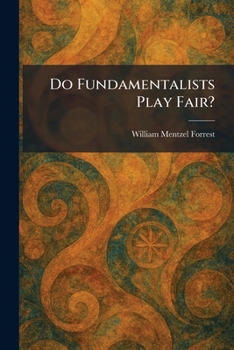
Do Fundamentalists Play Fair?

Select Format
Select Condition 
Book Overview
"Do Fundamentalists Play Fair?" is a compelling and rigorous examination of the intellectual and theological practices of the Fundamentalist movement during the height of the Fundamentalist-Modernist controversy. Written by scholar William Mentzel Forrest, the work delves into the heart of the religious and social tensions that gripped early twentieth-century thought. Forrest scrutinizes the methods used by proponents of fundamentalism to defend their doctrines, questioning the fairness and consistency of their arguments against scientific findings and modern biblical scholarship.
The book addresses critical themes such as the interpretation of scripture, the relationship between faith and reason, and the social implications of religious dogmatism. By analyzing the rhetoric and logic employed in the defense of traditional orthodoxy, Forrest provides a critical perspective on the conflicts between conservative theology and the emerging scientific worldview of his era. "Do Fundamentalists Play Fair?" serves as an important historical document, reflecting the intellectual debates of the 1920s while offering timeless insights into the nature of religious discourse and the pursuit of intellectual honesty. It remains a valuable resource for those interested in the history of American religion, theological ethics, and the evolution of modern thought.
This work has been selected by scholars as being culturally important, and is part of the knowledge base of civilization as we know it. This work was reproduced from the original artifact, and remains as true to the original work as possible. Therefore, you may see the original copyright references, library stamps (as most of these works have been housed in our most important libraries around the world), and other notations in the work.
This work is in the public domain in the United States of America, and possibly other nations. Within the United States, you may freely copy and distribute this work, as no entity (individual or corporate) has a copyright on the body of the work.
As a reproduction of a historical artifact, this work may contain missing or blurred pages, poor pictures, errant marks, etc. Scholars believe, and we concur, that this work is important enough to be preserved, reproduced, and made generally available to the public. We appreciate your support of the preservation process, and thank you for being an important part of keeping this knowledge alive and relevant.
Customer Reviews
ThriftBooks ® and the ThriftBooks ® logo are registered trademarks of Thrift Books Global, LLC
