


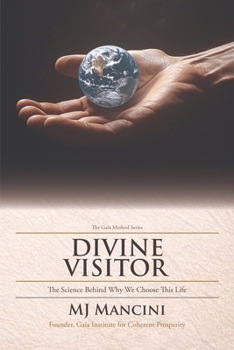
Divine Visitor

Divine Visitor: The Science Behind Why We Choose This Life
Most people live as if life happened to them. The day they arrived, the family they were born into, the body they were given, the difficulties that found them - all of it received as a hand dealt rather than a hand chosen. The framework that produces this default is so universal that few people notice they are running it. But the framework is not neutral. It is the source of a particular kind of fatigue that no amount of effort resolves.
For sixty years, three independent bodies of research - cosmological fine-tuning, contemplative neuroscience, and the University of Virginia's clinical archive of cases suggestive of memory across lifetimes - have been accumulating evidence that points in a single direction. The evidence has not been hidden. It has been ignored, because the framework most people inherit cannot incorporate it. Divine Visitor brings the three bodies of evidence into a single integrated case, in the institutional voice the evidence deserves and without the metaphysical embellishments the older vocabularies require.
The book follows six documented substrates across the cosmological, biological, and clinical evidence: a Tibetan monk whose brain has been characterized at higher precision than any other meditator on record; a Hollywood star whose first UNICEF mission to Ethiopia was the operational expression of her life's prior preparation; identical twins whose reunion at thirty-nine produced one of the most consequential findings in modern behavioral genetics; a Soviet geneticist who selected fifty-six generations of foxes for tameness; a boy in Louisiana whose verifiable verbal access to a 1945 naval pilot's death was documented before he could read; a Thai schoolteacher's re-entry traced across two villages and two decades. The cumulative case is what the title names.
Drawing on the work of Roger Penrose, Richard Davidson, Lynn Margulis, Ian Stevenson, and Jim Tucker, Divine Visitor is the foundational evidence text of the Gaia Method Series. This is not a faith claim. It is an evidence claim.
Customer Reviews
ThriftBooks ® and the ThriftBooks ® logo are registered trademarks of Thrift Books Global, LLC
