


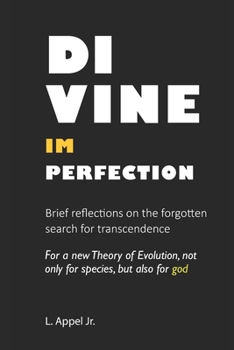
DIVINE IMPERFECTION Brief reflections on the forgotten search for transcendence: For a new Theory of Evolution, not only for species, but also for god
No Customer Reviews

Our reflection paradigms, both scientific and religious, need to change. Severe restrictions on reflection are imposed on both sides. The lack of direct measurable data related to a hypothetical transcendence underlying existence is immediately perceived as a definitive proof of its inexistence, although suggestive quantum paradoxes keep being solemnly ignored in this myopic search for a "definitive seal" to "scientific" materialism. Due to this prejudice, many do not allow themselves to "waste time" in an eventual existential questioning. But they do not realize that they only do so because they have surrendered to other people's ways of thinking, thus proving that they do not possess the true security and intellectual autonomy they claim to have. The religious mind, on the other hand, fearfully withdraws from anything that might compromise its beliefs, thus fossilizing its thoughts in archaic and millenary structures of the human past. A middle ground therefore needs to be found. I believe this midpoint could be defined as a "Cosmic Darwinism". If we follow this path, then several questions could be asked, without compromising any particular bias, whether scientific or religious... What would happen if we abandoned the religious concept of an assumed "divine perfection" and included the Creative Transcendental Principle, called by many simply "god", also in the evolutionary equation? Can "god" evolve? Would this notion be really a heretic paradox, or did Charles Darwin had recognized not only a biological reality, but a truly universal cosmological principle? If that were the case, could we then explain the Universe as the way in which the Transcendental Principle would realize this evolution? And could there be an evolutionary summit; a maximum limit on that, or would any type of limit be totally incompatible with the perspective of a divine evolution? Being the Transcendental Creative Principle something eternal; timeless, and therefore having always existed, never even having had a beginning, I think that we could not even speak of a limit for such an evolution, because if such a limit existed, then it certainly would have already been achieved. And without an apex for this evolution, could this system still be recognized as such? As an evolutionary process? Is the human creature a complete evolved species, or are we merely at the beginning of our development? Can evolutionary limits be thought of for biological species, or would such considerations simply derive from ancient religious obstructions imposed to the human mind? The fearful and obsessive fixation of the human animal on identities derived from conditionings of our cultural and religious past wouldn't thus be harmful and even fatal to the destiny of the human species? For there can be no immobility or constrain on the continuous transformative process, natural to a Creative Universe, without stagnation and decay following this. Do geocentrism and anthropocentrism truly belong to the human past, or do such notions still fully define humanity's reflective and behavioral directions? These are deconstructive questions. But the answers to them suggest perspectives that point to the beginning of a new way of thinking about human spirituality, much freer from all kinds of fundamentalisms and fanaticisms, which would bring benefits to all other branches of human interaction, thus increasing enormously the levels of empathy and tolerance that we are able to offer to our kind. It is worthwhile, therefore, to address these issues.
Format:Paperback
Language:English
ISBN:B08QRXR775
ISBN13:9798581889077
Release Date:December 2020
Publisher:Independently Published
Length:556 Pages
Weight:1.62 lbs.
Dimensions:1.1" x 6.0" x 9.0"
Customer Reviews
0 rating
Copyright © 2026 Thriftbooks.com Terms of Use
| Privacy Policy | Do Not
Sell/Share My Personal Information | Cookie Policy | Cookie Preferences | Accessibility Statement
ThriftBooks® and the ThriftBooks® logo are registered trademarks of Thrift Books Global, LLC
ThriftBooks® and the ThriftBooks® logo are registered trademarks of Thrift Books Global, LLC
