


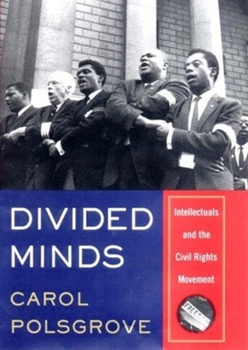
Divided Minds: Intellectuals and the Civil Rights Movement

Select Format
Select Condition 
Book Overview
A startling portrait of a generation of intellectuals who responded to the civil rights movement with peculiar ambivalence. No other movement in the twentieth century posed a starker moral challenge to the American intellectual tradition than that of civil rights. And yet the response of prominent writers and thinkers was surprisingly hesitant and ambivalent. William Faulkner spoke out for desegregation but, worried about violence, asked the North to "go slow." Richard Wright and W. E. B. Du Bois, marginalized by their radicalism, had difficulty being heard, while editors sought out the more moderate voices of C. Vann Woodward and Robert Penn Warren. Other, less patient voices did struggle to emerge, as Lillian Smith, Lawrence Dunbar Reddick, Howard Zinn, and James Silver put themselves at personal and political risk to air their views. But it was James Baldwin who threw down a gauntlet to other intellectuals in his brilliant and revolutionary The Fire Next Time. Here is a fascinating, untold history of our nation's most important moment, one rife with unaccountable bravery and inexplicable timidityboth often the products of the same divided minds.
Format:Hardcover
Language:English
ISBN:0393020134
ISBN13:9780393020137
Release Date:January 2001
Publisher:W W Norton & Co Inc
Length:296 Pages
Weight:1.48 lbs.
Dimensions:9.5" x 1.3" x 9.8"
Related Subjects
20th Century African Americans African-American Studies Biographical Biographies Biographies & History Biography & History Civil Rights & Liberties History Modern (16th-21st Centuries) Political Science Politics & Government Politics & Social Sciences Social Sciences Specific Demographics Specific Topics WorldCustomer Reviews
3 ratings
Slouching Towards Birmingham
Published by Thriftbooks.com User , 24 years ago
Carol Polsgrove has written an insightful and provocative commentary on the caution and reserve with which most of the nation's leading liberal intellectuals responded to the U.S. Supreme Court's 1954 ruling that institutionalized racial segregation was unconstitutional. She shows how the atmosphere of suspicion and fear of communist subversion generated by the McCarthy Era was used by those opposed to racial equality to smear the academics and intellectuals, both black and white, who spoke publicly in favor of desegregation, ruining their careers and diminishing their influence in the movement for civil rights. A series of personal stories involving public figures as diverse as William Faulkner, Ralph Ellison, Richard Wright, and Lorraine Hansberry keep the narrative constantly changing scene. But the central story involves the emergence of James Baldwin as the unlikely intellectual soul of the movement who gave voice to the rising anger and impatience among blacks for true social change. The author weaves a compelling, behind the scenes account of the first dozen years of the civil rights movement that adds deeper meaning to the hateful images of police dogs, fire hosings of marchers, National Guard troops separating black school children from angry white mobs and others that are seared into the collective consciousness. The author concludes with a pointed indictment of academic intellectuals who forsook the risk of invoking moral leadership in outage against the most enduring evil in American society in favor of the comfort and security of ivory tower discourses. Polsgrove has made an important contribution to illuminating what is surely one of the least inspiring eras of American intellectual history.
Slouching Towards Birmingham
Published by Thriftbooks.com User , 24 years ago
Carol Polsgrove's excellent work is a compelling account that has the feel of a behind-the-scenes report of how the U.S. Supreme Court's 1954 Brown v. Board of Education ruling began a slow evolution of political and intellectual thought that initially was muted and cautious in support of the emerging civil rights movement. Well-researched and thoughtfully written, the book fills in around many edges of the mental collage of hateful images that anyone growing up in America in the late 1950s and 1960s carries around with them today. Southern literary fans should particularly find the book illuminating. Anyone that did not grow up during the 1960s will find the book an essential reference. I highly recommend it.
Incisive commentary on key period in American history
Published by Thriftbooks.com User , 24 years ago
This book recounts recent history with the excitement of today's news. Participating in the civil rights movement required courage-- some intellectuals had it, and some didn't. The portrait of James Baldwin is particularly interesting, as is the discussion of novelist William Faulkner's off-again on-again public support of what he really knew to be right.
Copyright © 2026 Thriftbooks.com Terms of Use
| Privacy Policy | Do Not
Sell/Share My Personal Information | Cookie Policy | Cookie Preferences | Accessibility Statement
ThriftBooks® and the ThriftBooks® logo are registered trademarks of Thrift Books Global, LLC
ThriftBooks® and the ThriftBooks® logo are registered trademarks of Thrift Books Global, LLC
