


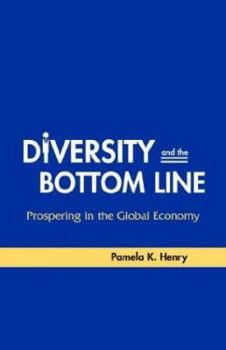
Diversity and the Bottom Line: Prospering in the Global Economy

No Synopsis Available.
Format:Paperback
Language:English
ISBN:0974003018
ISBN13:9780974003016
Release Date:May 2003
Publisher:TurnKey Press
Length:288 Pages
Weight:0.85 lbs.
Dimensions:9.0" x 0.8" x 5.0"
Customer Reviews
4 ratings
This is a great resource book!
Published by Thriftbooks.com User , 22 years ago
This book has everything a person interested in the field of diversity would want and it's very comprehensive. First, it has probably the best business case for diversity I've ever read. I really liked the fact that the author stuck to the bottom line implications of diversity and didn't stray into the philosophical or moral issues surrounding diversity. She really tells companies how they can leverage diversity to increase their profits. Second, the author's style is very straightforward. She supplements her arguments with facts and current statistics, and not leaps of faith. If you look at the end notes, you will see just how much research has gone into writing this book, which really adds to its credibility. Her chapter on the war for talent was especially compelling. She tells us that the shortage of skilled, technical labor is increasing. Worse, the U.S. is producing far fewer engineers needed to narrow this gap than many Asian and European competitors. The data the author presents is both convincing and scary at the same time. The numerous examples of costly mistakes companies have made by not understanding the cultures of the customers they were trying to sell to is interesting reading. It serves as a call to action for companies doing business in the global economy. The author does a good job of outlining the cost benefits of hiring right the first time. Replacement and retraining costs come right off the bottom line. Since the emerging workforce is increasingly diverse, her insights on how to source and recruit diverse talent are valuable. I also liked the chapter on creativity and how diversity creates greater bandwidth in experiences and perspectives that makes for better problem-solving and innovation. The author likens diversity to the "DNA" of creativity. Having no diversity at the table, she warns, is missing an opportunity to arrive at the "most elegant" solution. The tools that she includes in the second part of the book are awesome. Like I said, this is a great resource book for anyone interested in starting or managing a diversity program.
A Great Book
Published by Thriftbooks.com User , 22 years ago
As a result of reading this book, I have a much better understanding of the difference between affirmative action and diversity. The author really helped me understand the importance of culture in an organization. She reminds the reader that when people feel valued, they come to work more often, work harder, produce more - creating ROI for the company. When there is no commitment to an inclusive culture, factors that undermine productivity, which she calls "microinequities," emerge. This section of the book is very powerful. I also really enjoyed her chapter on "A Culture with Soul." This is what drove the importance of diversity home to me. She defines diversity very comprehensively (her "Dimensions of Diversity" graphic is the most comprehensive I've seen). She identifies the barriers to inclusion, defining concepts like "privilege," "labeling," and "collusion," briefly but completely. She defines what cultural competence is: how companies need to use different lenses and approach the emerging customer base, which is increasingly diverse, with much more due diligence about their cultures to be successful in the global economy. In other words, I have a much better appreciation for what diversity is and how it impacts the bottom line than I did before reading the book. It's more than numbers or diversity awareness training. It's about creating a culture that values and seeks out differences. I have always felt that leaders in corporate America really didn't "get it." The author underscores the important role that leaders play - how their skills and behaviors can support or undermine a culture based on trust and respect. She even has a chapter on leadership competencies. I now understand how important the processes and systems are in an organization as a means of supporting or sabotaging diversity. The best part of the book is Part II, where the author offers up strategies, components and tools to set up a diversity initiative. Her 9-S model is the best I've seen. I know from my own experience that one of the most difficult challenges in managing a diversity initiative is sustaining it. Her section and tools provided in the section, "Staying the Course," are the best I've ever seen. Anyone buying this book will get a complete, comprehensive cultural audit and an excellent example of a diversity scorecard. Many diversity efforts fail because they lack metrics. This book offers over 60!! Her strategies on effectively sourcing and recruiting diverse talent are also excellent. The list of resources she provides - books, articles, videos and websites - is the most comprehensive I've seen. In all, this book is jam-packed with useful, valuable information. It's the best, most comprehensive book I've read on the subject. Very affordable for what you get. You won't be disappointed.
Diversity and the Bottom Line
Published by Thriftbooks.com User , 22 years ago
This book is a bargain for anybody who's involved in diversity in the workplace. Pamela Henry has written the BEST argument I've ever read on why organizations need to start treating diversity seriously and incorporating it as a business strategy. She does so by discussing ten business "imperatives," which range from demographics, globalization and the war for talent, to business competencies like recruitment, retention, creativity and productivity. The author has done a lot of research. She also incorporates vignettes about her diversity experiences in Corporate America, sharing stories that really give the reader great insight into the advantages and challenges that diversity in the workplace offers. But that's not the best part of the book. The best is the second part in which Henry includes strategies, tactics, tools and metrics to launch and sustain a diversity initiative. She includes her 9-S model she's developed to give organizations a framework from which to plan and launch a diversity initiative. She includes great metrics and tools to ensure organizational accountability. The diversity scorecard is comprehensive. She even includes a cultural audit that is one of the best I've seen. Her insights into what skills and competencies leaders must acquire in order to create an inclusive culture that values all differences is really on target. So are her strategies and tactics for recruiting a diverse pipeline. This book needs to be read and utilized by companies that are serious about making a commitment to diversity and an inclusive culture. It's the best bargain going at $...
Diversity and the Bottom Line
Published by Thriftbooks.com User , 22 years ago
This is one of the better books I've read on diversity. As the author states, there has been a lot written about why diversity is the right thing to do - why it's the politically correct thing to do. But when diversity is positioned that way, it still feels like affirmative action. It's still a focus on numbers. It's still lip service by companies that are concerned about legal liabilities. What Henry does is take a much more pragmatic approach. She focuses on the positive, bottom line, results businesses can realize when they leverage diversity. This book really underscores how diversity can be a competitive advantage. The author delves into the changing demographics. Her statistics are great, showing us that the workforce of tomorrow is increasingly diverse. So is the customer base. I didn't realize that the purchasing power of minorities here in the U.S. has grown so substantially. Henry reminds us that they are increasingly selective as well in terms of which companies they'll choose to buy goods and services from. I really liked her examples of marketing gaffes made by companies who fail to take the diversity of their customers into account. As the author points out, these blunders are examples of opportunities lost and costs to the company that come right off the bottom line. I'm impressed by the research, facts and statistics that the author compiles. Her bibliography and recommended resources are quite impressive. This is a really compelling call to action for businesses trying to compete in the global economy. I now understand what the author means by diversity is a "global necessity" whose time has come. The author argues with good back-up data that diversity needs to be embraced by organizations and no longer merely tolerated.
Copyright © 2026 Thriftbooks.com
Terms of Use | Privacy Policy | Do Not Sell/Share My Personal Information | Cookie Policy | Cookie Preferences | Accessibility Statement
ThriftBooks ® and the ThriftBooks ® logo are registered trademarks of Thrift Books Global, LLC
ThriftBooks ® and the ThriftBooks ® logo are registered trademarks of Thrift Books Global, LLC
