


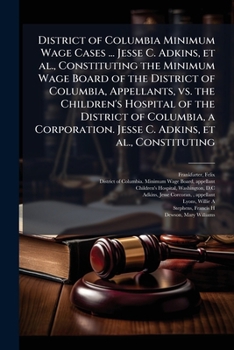
District of Columbia minimum wage cases ... Jesse C. Adkins, et al., constituting the Minimum Wage Board of the District of Columbia, appellants, vs.

Select Format
Select Condition 
Book Overview
This volume contains legal documents pertaining to the landmark Supreme Court case "Adkins v. Children's Hospital," a pivotal moment in the history of labor law and women's rights in the United States. The case, argued before the Supreme Court in the early 1920s, challenged the constitutionality of a minimum wage law for women in the District of Columbia. The appellants, including Jesse C. Adkins and the Minimum Wage Board of the District of Columbia, sought to defend the law, while the Children's Hospital challenged its validity.
The documents offer valuable insights into the legal arguments, social context, and economic considerations surrounding minimum wage legislation during this era. The case ultimately resulted in the Supreme Court striking down the law, a decision that had far-reaching implications for labor regulations and the role of government in protecting vulnerable workers. This collection is an essential resource for legal scholars, historians, and anyone interested in the ongoing debates about labor standards and constitutional interpretation.
This work has been selected by scholars as being culturally important, and is part of the knowledge base of civilization as we know it. This work was reproduced from the original artifact, and remains as true to the original work as possible. Therefore, you will see the original copyright references, library stamps (as most of these works have been housed in our most important libraries around the world), and other notations in the work.
This work is in the public domain in the United States of America, and possibly other nations. Within the United States, you may freely copy and distribute this work, as no entity (individual or corporate) has a copyright on the body of the work.
As a reproduction of a historical artifact, this work may contain missing or blurred pages, poor pictures, errant marks, etc. Scholars believe, and we concur, that this work is important enough to be preserved, reproduced, and made generally available to the public. We appreciate your support of the preservation process, and thank you for being an important part of keeping this knowledge alive and relevant.
Customer Reviews
ThriftBooks ® and the ThriftBooks ® logo are registered trademarks of Thrift Books Global, LLC
