


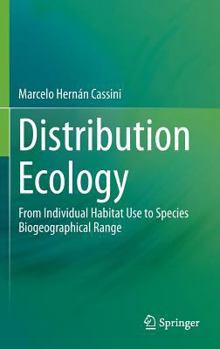
Distribution Ecology: From Individual Habitat Use to Species Biogeographical Range
No Customer Reviews

Select Format
Select Condition 
Book Overview
This book brings together a set of approaches to the study of individual-species ecology based on the analysis of spatial variations of abundance. Distribution ecology assumes that ecological phenomena can be understood when analyzing the extrinsic (environmental) or intrinsic (physiological constraints, population mechanisms) that correlate with this spatial variation. Ecological processes depend on geographical scales, so their analysis requires following environmental heterogeneity. At small scales, the effects of biotic factors of ecosystems are strong, while at large scales, abiotic factors such as climate, govern ecological functioning. Responses of organisms also depend on scales: at small scales, adaptations dominate, i.e. the ability of organisms to respond adaptively using habitat decision rules that maximize their fitness; at large scales, limiting traits dominate, i.e., tolerance ranges to environmental conditions.
Format:Hardcover
Language:English
ISBN:1461464145
ISBN13:9781461464143
Release Date:March 2013
Publisher:Springer
Length:217 Pages
Weight:1.11 lbs.
Dimensions:0.6" x 6.1" x 9.2"
Customer Reviews
0 rating
Copyright © 2026 Thriftbooks.com Terms of Use
| Privacy Policy | Do Not
Sell/Share My Personal Information | Cookie Policy | Cookie Preferences | Accessibility Statement
ThriftBooks® and the ThriftBooks® logo are registered trademarks of Thrift Books Global, LLC
ThriftBooks® and the ThriftBooks® logo are registered trademarks of Thrift Books Global, LLC
