


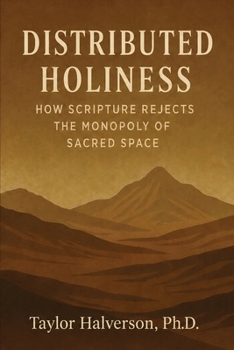
Distributed Holiness: How Scripture Rejects the Monopoly of Sacred Space

What if one of the Bible's most important themes has been hiding in plain sight?
Many readers assume holiness belongs primarily to temples, sacred buildings, religious institutions, and centralized authority. Yet from Genesis to Revelation, a different story unfolds.
In Distributed Holiness, Taylor Halverson, Ph.D., traces a remarkable biblical pattern: God repeatedly resists human attempts to monopolize the sacred. From Babel's tower to Solomon's temple, from imperial cities to religious bureaucracies, Scripture reveals a recurring tension between centralized holiness and God's desire to dwell among His people wherever covenant faith exists.
Journey through the Bible and the Book of Mormon to discover:
- Why Babel represents humanity's first attempt to control divine access
- How Abraham, Isaac, and Jacob encountered God far from temples and cities
- Why Sinai and the Tabernacle established a theology of mobile holiness
- How kings, cities, and temples reshaped Israel's religious imagination
- Why prophets repeatedly challenged centralized religious power
- How exile transformed Israel's understanding of God's presence
- Why Jesus brought holiness directly to ordinary people in villages, homes, and marketplaces
- How the early Christian movement shifted sacred space from buildings to communities
- What the Book of Mormon teaches about wilderness, belonging, and covenant society
- How Zion points toward a future where God's presence fills the whole earth
Drawing on biblical studies, ancient Near Eastern history, theology, and Restoration scripture, Distributed Holiness offers a fresh framework for understanding one of Scripture's grand narrative themes.
This book invites readers to see the Bible as the story of a God who refuses to be confined by towers, temples, palaces, institutions, or geography. He descends. He moves. He speaks. He dwells with His people.
The result is a powerful vision of holiness that is relational, covenantal, and available wherever faithful people seek God.
Customer Reviews
ThriftBooks ® and the ThriftBooks ® logo are registered trademarks of Thrift Books Global, LLC
