


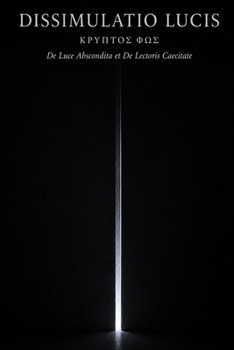
Dissimulatio Lucis: ??????S FOS — De Luce Abscondita et De Lectoris Caecitate

What is a boundary-and what warrants treating it as final?
Dissimulatio Lucis begins with light: Genesis, Maxwell, and quantum electrodynamics. From there it passes through symmetry, decoherence, observation, biological individuality, information, selfhood, consciousness, and the limits of formal description.
Across seven cantos, physics, philosophy, theology, mathematics, and biology are placed beside one another without being permitted to collapse into metaphor or easy synthesis.
The governing demand is severe: every crossing between domains must disclose its conditions.
Gauge freedom is not metaphysical relativism. Decoherence is not consciousness creating reality. Entanglement is not proof of cosmic unity. Information is not meaning. A boundary may be operationally indispensable without thereby becoming ontologically ultimate.
The question that persists is not whether distinction can be abolished, but what follows when a distinction cannot establish its own finality.
Part. Relation. Whole. Observer.
Written for readers comfortable with formal argument and disciplinary friction, Dissimulatio Lucis offers neither a popular-science simplification nor a reconciliatory metaphysics. Its subject is the cost of the boundary-and the position of the mind that draws it.
Customer Reviews
ThriftBooks ® and the ThriftBooks ® logo are registered trademarks of Thrift Books Global, LLC
