


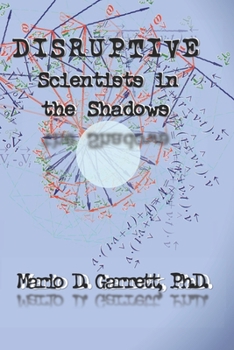
Disruptive Scientists in the Shadows
No Customer Reviews

Many academics have attempted to understand what science is. From Aristotle, who distinguished between "know how" and "know why", to the more contemporary Karl Popper, who argued that being able to disprove a theory is the foundation of science. But many other critics argue that science in the past was not refutable, and modern physics with Black Matter remains irrefutable. Thomas Kuhn, with his ill-defined concept of paradigm, however, gained great admiration for his theory of "revolutions." But revolutions are superficial because science is managed as a competition. Paradoxically, science only progresses cooperatively. There is no such thing as the lone genius. The denigrating of women (the Matilda effect) and minorities (the Mathew effect), and the litany of accusations of plagiarism, fraud, and expropriation, haunts nearly all disruptive scientists. We examine how all great revolutionary scientific theories were based on earlier work. Competition is promoted by powerful institutions and universities that control funding and, therefore the direction of science. The endgame is to find the truth, but we are only discarding old dogma and replacing it with new dogma. We are not progressing towards something; we are moving away from something. The ultimate objective of science is to find harmony; some visualize it as tracing the "hand of god" in creation. No wonder that most disruptive scientists are also religious. Religion is seen as a proto-paradigm and early theory of the universe in that it assumes that there is harmony and coordination among all things. Religion was the first theory in science. It is not distinct from science but an evolutionary stage. Now, with the development of Artificial Intelligence (AI), we have a new post-science paradigm. AI is already finding alternative physics; we could be faced with a technology that provides us with all the answers, yet without understanding how we got those answers. Much like religion, where they have all the answers without knowing the process. In our short history, science and religion have an opportunity to fuse as one. This has specific implications for the future of not just science and religion, but for humanity.
Format:Paperback
Language:English
ISBN:B0G26L98MR
ISBN13:9798274296076
Release Date:November 2025
Publisher:Independently Published
Length:424 Pages
Weight:1.24 lbs.
Dimensions:0.9" x 6.0" x 9.0"
Related Subjects
HistoryCustomer Reviews
0 rating
Copyright © 2026 Thriftbooks.com Terms of Use
| Privacy Policy | Do Not
Sell/Share My Personal Information | Cookie Policy | Cookie Preferences | Accessibility Statement
ThriftBooks® and the ThriftBooks® logo are registered trademarks of Thrift Books Global, LLC
ThriftBooks® and the ThriftBooks® logo are registered trademarks of Thrift Books Global, LLC
