


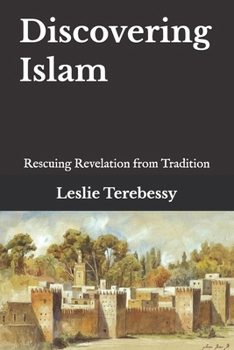
Discovering Islam: Rescuing Revelation from Tradition
No Customer Reviews

Knowledge of Islam requires understanding the relationship revelation, reason and tradition. All affect the way we understand religion. What is the proper relationship between revelation, reason and tradition? For the knowledge of this relationship was warped by the politicization of religion. In Islam, the politicization of Islam resulted from the requirement for the articulation of a justification of unlawful wars to enlarge the empire, jihad al-talab, treated as a "sixth pillar of Islam." Reinventing Islam as a teaching of war required the repression of reason. This enabled treating tradition as revelation and the subordination of revelation to tradition, reflected in the treatment of tradition as a "judge" of revelation. Thus, the knowledge of the relationship between revelation, reason and tradition requires rehabilitation. For the well-being of the umma depends on it. The problems of the umma - for example extremism - result from the corruption of the knowledge of revelation. The repression of reason and the treatment of tradition as "revelation form God" tradition warped the knowledge of revelation. Knowledge was also corrupted by recourse to the teaching of abrogation. The treatment of tradition as "revelation from Allah" produced "traditional Islam." The "abrogation" of the verses of reconciliation by the verse of the sword produced political Islam. Both misrepresent Islam as taught in the Book of Allah. Traditionists required an Islam that would pacify the masses, by making them subservient to rulers. This was expedited by recourse to the teaching of predestination and traditions requiring unquestioning following of tradition. Hawkish rulers required a rendition of Islam that would provide a "religious" justification for waging wars of aggression, prohibited in revelation. Mercenary ulama stepped up to the challenge and recast Islam, the religion of reconciliation, as a religion of war. The "abrogation" of the verses of reconciliation was justified by recourse to verses 9:29 and 9:5. The "religious" justification of wars of aggression catered to the expansionary agenda of rulers, within the epic struggle between the abode of peace (dar al-Islam) against the abode of non-belief (dar al-kufr). The turn from revelation to tradition was reflected in the recording of traditions. The turn was expedited by the repression of reason. Further errors encompass the perception that tradition can "abrogate" and "replace" parts of revelation. Jurists allegedly possess the power to "abrogate" and "replace" revealed rulings, too. The renewal of the umma requires a return to the Book of Allah. The rehabilitation of the knowledge of revelation requires a reengagement of reason. The "eclipse" of revelation by tradition placed revelation under the jurisdiction of tradition in exegesis, jurisprudence, and international relations. Tradition became a furqan over Allah's Furqan. Tradition superseded revelation. In exegesis, tradition is treated as "revelation from God." In jurisprudence, rulings from tradition and the ulema at times replace revealed rulings. In politics, ruling elites engaged in wars of aggression, waging jihad al-talab. Retaliation for aggression triggered the fall of the empire. The past is riddled with catastrophes. What to do? While revelation emphasises justice, ethics and reason, we find no books on justice, rationality, or morality in Bukhari. What kind of Islam are we getting from "tradition"? Is it Islam without justice, ethics and reason? Is it the Islam of the Quran? Is it the Islam of revelation or the Islam of tradition? Have the practices of the predecessors eclipse the revealed word of God? Did the umma turn from revelation to tradition? Has tradition superseded revelation? Has tradition provided reliable knowledge to the Muslim umma? Does revelation expect us to follow tradition or revelation?
Format:Paperback
Language:English
ISBN:B09SP827XY
ISBN13:9798420177419
Release Date:February 2022
Publisher:Independently Published
Length:258 Pages
Weight:0.77 lbs.
Dimensions:0.5" x 6.0" x 9.0"
Customer Reviews
0 rating
Copyright © 2026 Thriftbooks.com
Terms of Use | Privacy Policy | Do Not Sell/Share My Personal Information | Cookie Notice | Cookie Preferences | Accessibility Statement
ThriftBooks ® and the ThriftBooks ® logo are registered trademarks of Thrift Books Global, LLC
ThriftBooks ® and the ThriftBooks ® logo are registered trademarks of Thrift Books Global, LLC
