
Skip to content
Scan a barcode
Scan
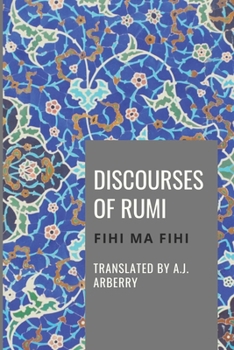
Paperback Discourses of Rumi: Fihi Ma Fihi Book

ISBN: B085K8NW5G

ISBN13: 9798621775971

Discourses of Rumi: Fihi Ma Fihi

Select Format

Select Condition ThriftBooks Help Icon

Recommended

Format: Paperback

Condition: New

$19.24
Ships within 2-3 days
Save to List

Book Overview

Jalal Ad-Din Rumi, the towering light of Sufi wisdom is rightly known as Moulavi Ma'anavi, the gnostic scholar - in the Muslim world. He has been considered as the peak of spiritual excellence and insightful divine sagaciousness by the seekers of the inner meanings of words and worlds. Everyone with a genuine bend for true knowledge turns to Rumi, irrespective of caste and creed, to quench their thirst.

When Rumi refers to Islam, he is talking about The way. He is not talking about the preconceived notions that people have about Islam today, or even in his day, but the spiritual path itself and the religious tradition.

Fihi Ma Fihi is the most famous prose work of Rumi. It's a collection of 71 discourses on various topics directly connected to everyday life. Rumi delivered these speeches to middle audience. The title of the book means 'In it what is in it' or 'It is what it is'. It is said that the Sultanul Walad, the eldest son of Rumi, compiled the speeches with the help of his other disciples, Rumi explains their important principles of Sufism in transparent terms in this book. Fihi Ma Fihi can be considered as a right introduction to Mathnavi. Fihi Ma Fihi provides explanations and keys to unlock the meaning of the Mathnavi. Rumi's most famous work.

The two works were written parallel to each other, and contain many references and stories that are continued from one to the other.

Customer Reviews

4 ratings

Man is the Astrolabe of God

In Arabic this book was known as "Fîhî ma Fîhî", which means, unhelpfully, "In It What Is In It". It consists of conversations between the great Sufi and those who came to see him, recorded by his followers. Any subject can and does come up, and the Master's associations of ideas are subtle and far-reaching. Just as he could improvise sublime lyric poetry when the mood struck him, here he creates profound spiritual teachings out of chance remarks and faint suggestions. If you're familiar with Rumi and want to go beyond occasional delight and inspiration in his poetry, to learn more about him and his teachings, this may be the easiest point of entry. It catches Rumi off-guard, or rather shows he was never off-guard: it's the next best thing to having home movies of him. I have known and loved the A.J. Arberry translation for years. Arberry was the greatest English Islamic scholar of his generation, I have nearly all his books, and if his grave were within 1000 kilometres I would place anemones on it regularly... BUT... I must confess that when translating from Arabic or Persian, he felt compelled to use an odd old-fashioned English of no time or place, an invention of his own. I got accustomed to phrases like "Mannikin, God exists of a certainty" or "Whatsoever thou soughtest". I will miss them, to be honest. But for 99% of the population, a translation into idiomatic modern English will be an unmixed blessing. Don't be put off by the way Rumi seems to drift from topic to topic or suddenly leap off in some entirely unexpected direction. This is not a mistake; he was not getting confused in his old age. He was wide awake and he wants to keep you awake.

A Noble Effort

Professor Thackston has done admirably with this translation of "Fihi ma fihi." Especially since, in my opinion, this is the hardest of Rumi's works to translate.In his poetry, Rumi is sublime, and accordingly difficult to translate, but any translator can only do so much with a poem. If you miss some nuances, it's just the tradeoff that the translator of poetry must make. The "Masnavi", on the other hand, is a lengthy work, but it has a coherence that makes the translator's life relatively easy and compels the reader on."Fihi ma fihi", however, very often seems to ramble off in a thousand directions. Indeed, sometimes it's hard to escape the feeling that this book was Rumi's attic, all full of jumbled odds and ends, many of them beautiful, but not necessarily in any coherent order. In fact, however, a second reading can reveal that the book is a great deal more than that. If you have been under the impression that Rumi is a sort of Omar Khayyam for the New Age, this book can convince you that just possibly he belongs in company with Shakespeare, Goethe and Pushkin.This translation is eminently readable and even prods the reader on. Professor Thackston has certainly succeeded in translating Rumi's infallible knack to make us look at the world through different eyes. The one sacrifice was Rumi's elegant rhetoric, which just can't be translated. For that you'll have to learn Farsi. In the meantime, this book is to be enjoyed.

Rumi - The Greatest Poet of the "intoxicated" Sufi School

It is the translation of Fihi Ma Fihi, which is full of Rumi's discourses. It sort of dispells all notions of "sufism vs islam" rather sufism is Islamic Mysticism in the truest sense and Rumi explains why the outter conformity to the Sharia (Sacred Law)is very important (i.e. the religous dispensations that are given to mankind through the last of the revalatory Porphet, according to Islam; Prophet Muhammed saws). He himself was a Hanafi (one of the four schools of law within the Orthodox Islam).The book really clarifies his thoughts and ideas behind the poems. Lot of western readers of his poems tend to use his semantics and syntex to project their own meaning to it rather than discover the deep insights and the Reality he is trying to point toward. "I am the servant of the Qur'an While I am still alive.I am the dust on the path of Muhammad, the Chosen One."(Mevlana Jelaluddin Rumi) http://www.jerrahi.org/writings_english/invitation.htm

For the Dreamer of God's Logic

Rumi's discourses are really not so different from his poetry. In each he tries to make the listener (because his style is essentially teacher speaking to apprentice) understand that it is LOGICAL to see how much God loves each person. Because it is more difficult for the rest of us to see what is obvious to those so touched with delight by the intimate presence of God, he uses emotions to convey what to him is the logic. He thus uses poetic language to convey the message, since we find it easier to "understand" an emotive content. Much as Christ spoke in what must have seemed to many impossibly hard-to-understand metaphors, Rumi's discourses do often require an extraordinary "letting go" to sense the logic in his argument. An important work for all the ages.
Copyright © 2026 Thriftbooks.com Terms of Use | Privacy Policy | Do Not Sell/Share My Personal Information | Cookie Policy | Cookie Preferences | Accessibility Statement
ThriftBooks® and the ThriftBooks® logo are registered trademarks of Thrift Books Global, LLC

GoDaddy Verified and Secured