


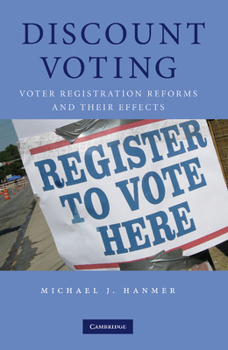
Discount Voting: Voter Registration Reforms and Their Effects
No Customer Reviews

In the U.S., there is wide variation from state to state in the institutional arrangements - for example, registration laws - that structure the environment in which citizens decide whether to vote and parties decide whom to mobilize. This has important consequences for who gets elected and the policies they enact. Hanmer argues that to understand how these institutional arrangements affect outcomes, it is necessary to consider the interactions between social and political context and these laws. He tests this theory by examining how the factors that influence the adoption of a set of registration laws affect turnout, the composition of the electorate, and party strategies. His multi-method research design demonstrates that the effect of registration laws is not as profound as either reformers would hope or previous studies suggest, especially when reform is a response to federal legislation. He concludes by arguing for a shift in the approach to increasing turnout.
Format:Paperback
Language:English
ISBN:1107406129
ISBN13:9781107406124
Release Date:August 2012
Publisher:Cambridge University Press
Length:266 Pages
Weight:0.87 lbs.
Dimensions:0.6" x 6.0" x 9.0"
Customer Reviews
0 rating
Copyright © 2026 Thriftbooks.com Terms of Use
| Privacy Policy | Do Not
Sell/Share My Personal Information | Cookie Policy | Cookie Preferences | Accessibility Statement
ThriftBooks® and the ThriftBooks® logo are registered trademarks of Thrift Books Global, LLC
ThriftBooks® and the ThriftBooks® logo are registered trademarks of Thrift Books Global, LLC
