


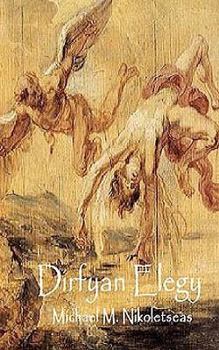
Dirfyan Elegy: Poems of Passage
No Customer Reviews

Harvard University Libraries. *Dirfyan Elegy: Poems of Passage* by Michael M. Nikoletseas is a poignant and evocative collection of poetry that weaves together themes of memory, loss, identity, and the interplay between the human spirit and the natural world. Published in 2010 and revised in 2013, this bilingual work-presented in both English and Greek-draws heavily on the cultural and mythological heritage of Greece, particularly the Euboean landscape, while engaging with universal human experiences. Through its 13 poems, including titles such as "Genesis," "The Dance," "Ocean Blood," and "Exodus," the collection explores the tension between creation and destruction, presence and absence, and the fleeting nature of connection. The imagery in *Dirfyan Elegy* is steeped in the natural and mythological landscapes of Greece-Euboea's seas, Dirfy's slopes, and references to kouroi (ancient Greek statues of young men) and Gorgons. These elements serve as both literal and metaphorical anchors, tying the poems to a specific place while exploring timeless themes. The recurring motif of eyes, as seen in poems like "The Wounded Hare" and "Fugue," symbolizes perception, longing, and the search for meaning, often juxtaposed against images of darkness, stone, and the sea. ### Thematic Depth
At its core, *Dirfyan Elegy* is a meditation on human fragility and resilience. The opening poem, "Genesis," sets the tone with its creation myth-like imagery: "Small city / Deep Inside / The darkness of our minds." This establishes the collection's exploration of the inner world as a microcosm of the external, where streets, temples, and gardens reflect both personal and collective consciousness. The poem's invocation of divine will-"And God said / Their will be done / And there was"-introduces a tension between fate and agency that reverberates throughout the work. Poems like "The Dance" and "Ocean Blood" evoke a primal connection to the earth and sea, blending sensuality with violence. In "The Dance," the image of "Snow in the spring brings forth birds / With arms stretched out" captures a moment of renewal tainted by transience, while "Ocean Blood" conjures a mythic Euboean kouros whose "muddy neck shudders" with "Seaweeds Gorgons and Mega-Alexanders." These images fuse the ancient with the visceral, suggesting a cyclical struggle between creation and decay. The collection also grapples with themes of loss and alienation. In "Farewell," the speaker laments a fractured connection, with "Stone arms ahead / Split your heart in two," while "The Wounded Hare" universalizes suffering through the shared gaze of a hare, an orphan boy, and those "who departed in solitude." The recurring call to "Hide the boy" in poems like "Farewell" and "The Little Rabbit" suggests a protective instinct against a world that threatens innocence, symbolized by "blue eyes" and "a broad smile." This motif, paired with references to Thermopylae and Saint George, invokes a heroic yet tragic resistance against overwhelming forces. ### Conclusion
*Dirfyan Elegy* is a haunting and deeply personal work that bridges the ancient and the modern, the local and the universal. Michael M. Nikoletseas crafts a poetic landscape where Euboea's seas and mountains become a stage for exploring love, loss, and the enduring human spirit. While its elliptical style and cultural specificity may not appeal to all readers, those willing to immerse themselves in its imagery and bilingual resonance will find a rewarding meditation on memory and identity. This collection is a testament to the power of poetry to preserve what is fleeting, carving "words that will blossom memories" on the stone of human experience.
At its core, *Dirfyan Elegy* is a meditation on human fragility and resilience. The opening poem, "Genesis," sets the tone with its creation myth-like imagery: "Small city / Deep Inside / The darkness of our minds." This establishes the collection's exploration of the inner world as a microcosm of the external, where streets, temples, and gardens reflect both personal and collective consciousness. The poem's invocation of divine will-"And God said / Their will be done / And there was"-introduces a tension between fate and agency that reverberates throughout the work. Poems like "The Dance" and "Ocean Blood" evoke a primal connection to the earth and sea, blending sensuality with violence. In "The Dance," the image of "Snow in the spring brings forth birds / With arms stretched out" captures a moment of renewal tainted by transience, while "Ocean Blood" conjures a mythic Euboean kouros whose "muddy neck shudders" with "Seaweeds Gorgons and Mega-Alexanders." These images fuse the ancient with the visceral, suggesting a cyclical struggle between creation and decay. The collection also grapples with themes of loss and alienation. In "Farewell," the speaker laments a fractured connection, with "Stone arms ahead / Split your heart in two," while "The Wounded Hare" universalizes suffering through the shared gaze of a hare, an orphan boy, and those "who departed in solitude." The recurring call to "Hide the boy" in poems like "Farewell" and "The Little Rabbit" suggests a protective instinct against a world that threatens innocence, symbolized by "blue eyes" and "a broad smile." This motif, paired with references to Thermopylae and Saint George, invokes a heroic yet tragic resistance against overwhelming forces. ### Conclusion
*Dirfyan Elegy* is a haunting and deeply personal work that bridges the ancient and the modern, the local and the universal. Michael M. Nikoletseas crafts a poetic landscape where Euboea's seas and mountains become a stage for exploring love, loss, and the enduring human spirit. While its elliptical style and cultural specificity may not appeal to all readers, those willing to immerse themselves in its imagery and bilingual resonance will find a rewarding meditation on memory and identity. This collection is a testament to the power of poetry to preserve what is fleeting, carving "words that will blossom memories" on the stone of human experience.
Format:Paperback
Language:English
ISBN:1451543786
ISBN13:9781451543780
Release Date:April 2010
Publisher:Createspace Independent Publishing Platform
Length:70 Pages
Weight:0.17 lbs.
Dimensions:0.1" x 5.0" x 8.0"
Related Subjects
PoetryCustomer Reviews
0 rating
Copyright © 2026 Thriftbooks.com Terms of Use
| Privacy Policy | Do Not
Sell/Share My Personal Information | Cookie Policy | Cookie Preferences | Accessibility Statement
ThriftBooks® and the ThriftBooks® logo are registered trademarks of Thrift Books Global, LLC
ThriftBooks® and the ThriftBooks® logo are registered trademarks of Thrift Books Global, LLC
