


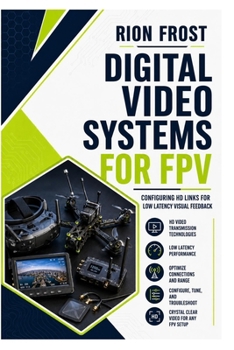
Digital Video Systems for FPV: Configuring HD Links for Low Latency Visual Feedback

A clear picture can make the difference between a confident flight and a frustrating one.
When your aircraft is moving fast, travelling farther away, or flying through a difficult environment, you need more than an expensive camera and a powerful transmitter. Every part of the setup must work together-from the camera and encoder to the antenna, receiver, goggles, display, power supply, and recording equipment.
Digital Video Systems for FPV gives you a practical way to understand, select, install, and improve the equipment that carries your live picture from the aircraft to the pilot.
Instead of overwhelming you with unexplained specifications, this guide shows you what each component does, how the parts affect one another, and why some setups perform well while others suffer from delay, breakup, interference, poor range, or sudden signal loss.
Inside, you'll learn how to:
- Choose equipment that matches your aircraft and flying goals
- Understand resolution, frame rate, bandwidth, compression, and transmission delay
- Position antennas correctly and select suitable polarization
- Reduce interference from motors, power wiring, and nearby transmitters
- Balance picture quality, response time, range, weight, and power consumption
- Connect cameras, air units, receivers, goggles, monitors, and recorders
- Improve performance without replacing every component
- Diagnose freezes, image breakup, weak reception, overheating, and connection problems
- Carry out bench, ground, and range checks before takeoff
- Create a dependable setup for racing, freestyle flying, exploration, filming, or long-distance use
The explanations are straightforward, practical, and based on the way these installations behave in real conditions. You won't simply be told which specification is bigger or better. You'll learn how to make informed choices based on your aircraft, environment, budget, and acceptable level of risk.
Whether you're assembling your first advanced viewing setup or trying to solve problems in an existing build, this book will help you create a clearer, faster, and more dependable connection between the aircraft and the pilot.
Stop guessing which component is causing the problem. Understand the complete signal path and build a setup you can trust when it matters most.
Customer Reviews
ThriftBooks ® and the ThriftBooks ® logo are registered trademarks of Thrift Books Global, LLC
