


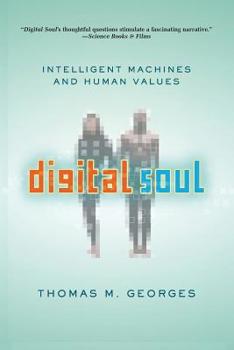
Digital Soul: Intelligent Machines and Human Values


Select Format
Select Condition 
Book Overview
Should the day come when intelligent machines not only make computations but also think and experience emotions as humans do, how will we distinguish the "human" from the "machine"? This introduction to artificial intelligence -- and to its potentially profound social, moral, and ethical implications -- is designed for readers with little or no technical background. In accessible, focused, engaging discussions, physicist and award-winning science writer Thomas Georges explores the fundamental issues: What is consciousness? Can computers be conscious? If machines could think and even feel, would they then be entitled to "human" rights? Will machines and people merge into a biomechanical race? Should we worry that super-intelligent machines might take over the world? Even now we continue to put increasingly sophisticated machines in control of critical aspects of our lives in ways that may hold unforeseen consequences for the human race. Digital Soul challenges all of us, before it's too late, to think carefully and rationally about the kind of world we will want to live in -- with intelligent machines ever closer by our sides.
Format:Paperback
Language:English
ISBN:081334266X
ISBN13:9780813342665
Release Date:October 2004
Publisher:Basic Books
Length:296 Pages
Weight:0.75 lbs.
Dimensions:0.8" x 5.9" x 8.6"
Customer Reviews
2 ratings
One of Several Useful Books on Artificial Intelligence, but not an Exceptional One
Published by Thriftbooks.com User , 19 years ago
In recent years a spate of books has appeared on the rise of intelligent machines and what that might mean for the future of humanity. "Digital Soul" is among them, and it purports to be a basic introduction to the subject of artificial intelligence and the future. Clearly written and at times engaging, "Digital Soul" asks a range of interesting questions: What defines life? What defines consciousness? Can a machine be alive, can it be conscious? If either alive or conscious does a machine the have rights and privileges that we extend to other living things? Do intelligent machines pose a threat to humanity as depicted in many popular science fiction books and film? Unfortunately, Thomas M. Georges does not offer a sustained and penetrating analysis of them. Georges suggests that the creation of sentient artificial intelligence is a virtual surety in the twenty-first century if the current level of advancement is maintained. Such a development, he believes, would force humanity to reconsider their everyday beliefs, scientific perspectives, political relations, and religious conceptions. As he put it, the creation of "superintelligent extraterrestrials" living among us on Earth must prompt a rethinking of deeply held beliefs and values. This is a modest explication of a complex subject. It may be read with profit as an introduction of the possibilities for the future of artificial intelligence. But there are several other books of a similar nature that deserve more sustained consideration. For instance, after reading "Digital Soul" please also consider Ray Kurzweil, "The Age of Spiritual Machines: When Computers Exceed Human Intelligence" (Penguin, 1998); Peter Menzel and Faith D'Aluisio, "Robo Sapiens: Evolution of a New Species" (MIT Press, 2000); Rodney Brooks, "Flesh and Machines: How Robots Will Change Us" (Pantheon, 2002); Sidney Perkowirz, "Digital People: From Bionic Humans to Androids" (Joseph Henry Press, 2004); James Hughes, "Citizen Cyborg: Why Democratic Societies Must Respond to the Redesigned Human of the Future" (Westview Press, 2004); and Joel Garreau, "Radical Evolution: The Promise and Peril of Enhancing Our Minds, Our Bodies--And What It Means to Be Human" (Doubleday, 2005). Even so, I have yet to find a really outstanding book on this subject written at an introductory level. I will continue my search. Meantime, "Digital Soul" is one among several works that is useful, but not path breaking.
Where are we going?
Published by Thriftbooks.com User , 23 years ago
And will "we" still be here when we get there?Digital Soul is about the nature of our world when machines become as intelligent as humans and beyond. It is also about the nature of those machines. It is clear that Georges has thought long and hard about the subject, has read widely and has compared notes with other futurists. His expression is reasoned and reasonable. There are no muddy sentences or mystical ambiguities. He has worked hard to make sure that his ideas are accessible to a wide range of people including those with no expertise in the field of Artificial Intelligence.Clearly the problem is to derive benefit from super intelligent machines without letting them take over our lives. Georges believes that it will be difficult to do that since, as the machines get smarter and smarter and we allow them more and more latitude and we more and more depend on them, they will come to control us.But this is where I think Georges goes astray. The question I would ask is, would they WANT to control us?Georges implies that human-like values, such as that of self-preservation will automatically follow from machines becoming intelligent. But actually the machines will have no values at all and no desire, either. They will have no inclination to act except as such inclinations are built into their make-up.Georges also implies that he knows what qualities or values are desirable in a machine. He speaks of "nicer, testosterone-free, superhuman beings" as opposed to "greedy, violent, barbaric, self-absorbed" beings. (p. 212) While these are surely agreeable preferences, it is not clear that artificial creatures designed according to human choice would long survive.It is also not clear that we would want to design machines according to human values. We would want to design them as tools (which they are) to assist us in following our desires and supporting our values. Notice the difference. Machines that work toward fulfilling the desires and upholding the values of human beings are not the same as machines that contain the desires and values of human beings.What I think Georges temporarily forgets is that no machine is going to "want" to do anything unless "desire" is built into the machine. The machine doesn't care whether it is plugged in or not unless we somehow encode such a desire into the machine. What Georges seems to assume is that somehow the complexity that we will demand from machines will somehow necessitate that we inculcate desire, self-preservation and the like into the machine. I think this will not be necessary at all. Indeed I suspect our machines will tell us that they will be able to function just fine without the institution of some kind of supercode or primary instruction telling them to protect themselves and have ulterior motives. (Such notions led to HAL 9000's murderous behavior in Kubrick's film 2001: A Space Odyssey.)I think a more likely future (and one that Georges addresses) is a symbiosis between people a
Copyright © 2026 Thriftbooks.com
Terms of Use | Privacy Policy | Do Not Sell/Share My Personal Information | Cookie Policy | Cookie Preferences | Accessibility Statement
ThriftBooks ® and the ThriftBooks ® logo are registered trademarks of Thrift Books Global, LLC
ThriftBooks ® and the ThriftBooks ® logo are registered trademarks of Thrift Books Global, LLC
