


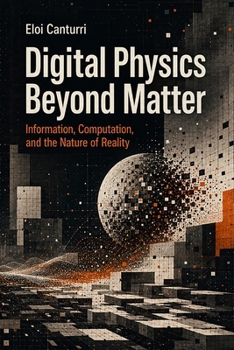
Digital Physics Beyond Matter: Information, Computation, and the Nature of Reality
No Customer Reviews

What if matter is not fundamental? What if the universe is better understood as information being processed according to rules? Digital Physics Beyond Matter: Information, Computation, and the Nature of Reality explores one of the most provocative ideas in modern physics and philosophy: that reality may be computational at its deepest level. Beginning with the work of Konrad Zuse, Edward Fredkin, John Archibald Wheeler, Stephen Wolfram, Gerard 't Hooft, Seth Lloyd, J rgen Schmidhuber, Max Tegmark, and others, the book examines how simple rules might generate particles, forces, space, time, quantum behavior, observers, and entire universes. It explains cellular automata, reversible computation, algorithmic information, causal sets, quantum cellular automata, holography, emergent spacetime, and the possibility that every computable world exists. The book also confronts the problems enthusiasts prefer to leave quietly behind the curtain. Can a discrete universe preserve relativity? Can deterministic rules reproduce quantum mechanics? Why do probabilities follow the Born rule? What distinguishes genuine computation from a clever redescription? Can digital physics make predictions that differ from conventional theories, or is it only a philosophical interpretation wearing a laboratory coat? Written for modern readers who want clarity without oversimplification, Digital Physics Beyond Matter combines scientific detail, philosophical analysis, and a healthy distrust of grand claims. It does not assume that the universe is a computer. It asks what that statement could mean, what evidence might support it, and where the idea begins to collapse under its own ambition.
Format:Paperback
Language:English
ISBN:B0HBQQ6ZF3
ISBN13:9798189356858
Release Date:July 2026
Publisher:Independently Published
Length:230 Pages
Weight:0.69 lbs.
Dimensions:0.5" x 6.0" x 9.0"
Customer Reviews
0 rating
Copyright © 2026 Thriftbooks.com
Terms of Use | Privacy Policy | Do Not Sell/Share My Personal Information | Cookie Policy | Cookie Preferences | Accessibility Statement
ThriftBooks ® and the ThriftBooks ® logo are registered trademarks of Thrift Books Global, LLC
ThriftBooks ® and the ThriftBooks ® logo are registered trademarks of Thrift Books Global, LLC
